
CONCLUSIONS AND SYNTHESIS
One cannot help but be amazed that a book of symbols initially intended as a method of oracular prediction was transformed by philosophers over centuries into a foundational text of metaphysics and ethics. Today I hope to summarize their discoveries and integrate them into a modern philosophical perspective.
Most importantly we see ultimate reality for these thinkers is derived from their direct observations of nature and their knowledge of the cosmos. I am reminded of the wisdom of the ancient native Americans discussed in earlier blogs.24 However I also see a parallel with Hinduism’s emphasis on direct experience of the world and of the inner self.
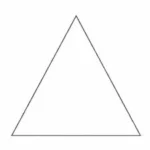 The I Ching tells us that change is the only constant in realty – the one aspect of it we all must accept, embrace, and factor in all our endeavors. Ultimate reality seems to be distilled into an equilateral triangle with nature, cosmos, and humanity at its three vertices within which continual change occurs.25 We also see ultimate reality involves polarities, especially yang and yin, but also motion and rest, macrocosm and microcosm, alternation and transformation – all of which are instantiated in change. The analogy to ‘being’ and ‘becoming’ in Western philosophy jumps out at us. The I Ching also uses symbols (not unlike in the West – consider numerals and musical notes) to show that change is not chaotic, but informs a mathematical order and musical harmony within the universe. Cosmologists and philosophers alike can appreciate this characterization of ultimate reality.
And the I Ching provides a clear summum bonum for human striving – ‘the sublime’ or ‘sublime success.’ The ‘sublime’ is not overtly defined, but seems to refer to the highest level of purity and goodness intrinsic to the world which we can activate by careful conformity with nature and humble recognition of our limitations. This formula offers all of us the opportunity to guide change in the world in order to achieve our own ethical purpose and final meaning.
Who expected all of this from a text so neglected in the West?
———————————————
24See posts date 3/31/21 and 4/2/21 – http://philosophicalguidance.com/2021/03/31/cosmic-virtue-and-nature-part-vii-native-american-view/ and http://philosophicalguidance.com/2021/04/02/3555/
25The Confucians seem to emphasize the human angle, while the Taoists seem to emphasize the nature angle. We will come back to this as we examine later thinkers.
—————————————–
Having trouble leaving a question or comment? E-mail me at gregoryciliberti@gmail.com


