
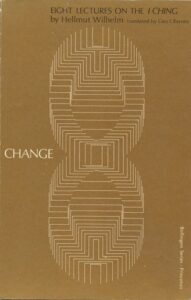
 The I Ching teaches there are two kinds of change: alternation and transformation. This duality is explained by a second kind of polarity – motion and rest – each of which manifests in the two forces: yang or ‘firm’(the Creative) represented by the unbroken line, and yin or ‘yielding’ (the Receptive) represented by the broken line.12
“In a state of rest, the Creative is one, and in a state of motion it is straight; therefore it creates that which is great. The Receptive is closed in a state of rest, and in a state of motion it opens; therefore it creates that which is vast.”13
Alternatively, the firm line has unity for its quality, is one-dimensional, and is the image of the human mind while the yielding line shows vegetative movement and is the symbol of the human soul.
In any case, alternation is the change which occurs when the two forces are at rest while transformation occurs when there is motion. On the one hand motion in the unbroken line is an outward pushing by which it becomes thinner in the middle and breaks into two. On the other hand motion in the broken line is an inward pushing that forms an undivided line. The symbolism is clear; in any circumstance, transformation or reversal can occur adding novel or unexpected elements to the situation.14
Wilhelm tells us:
“…this principle of reversal of qualities also contains a maxim for action…which takes us a step further than the mere possibility of conformity in our actions… an unresisting acceptance of developments, sweeps one into the current of events from which escape is no longer possible. Only by taking up a counterposition, by confronting events with live awareness can developments be guided into the desired paths.”15
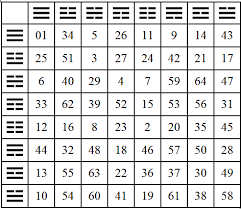
 Wilhelm next offers a somewhat detailed discussion of specific hexagrams and their attendant commentary that goes beyond the scope of this site. However some concepts he discusses expand our understanding of ultimate reality in the I Ching. First it projects a mathematical order on the universe within which the hexagrams inform a kind of mystical periodic table. Second, cosmic order in the I Ching is analogous to music as exhibited by the harmony of the hexagrams and the unfolding of symphonic-like themes and variations which humans appreciate when they seek the perfection of these expressions within the natural world.16
Thirdm we learn the pinnacle of reality in the I Ching is the ‘sublime.’ From the Judgment or Tuan text, the first quality of heaven in its cyclic movement is yüan or the ‘sublime beginning.’ Combined with heng or pushing through to success, li or utility, and chen or perseverance, the cycle of creativity develops and coordinates with cosmic and human activity uniting all in ‘sublime success’ which includes beauty and justice.17 Wilhelm provides two quotations:
“Great indeed is the sublimity of the Creative, to which all things owe their beginning and which permeates heaven.”18
“Of all that is good, sublimity is supreme. Succeeding is the coming together of all that is beautiful. Furtherance is the agreement of all that is just. Perseverance is the foundation of all actions.”19
(third continuation next post)
———————————————
12Wilhelm, Hellmut, Change – Eight Lectures on the I Ching. Princeton University Press, Princeton New Jersey, 1973. ISBN 0-691-01787-5, page 33.
13Ibid.
14Ibid.
15Ibid., page 34.
16Ibid., pages 48-49.
17Ibid., page 51.
18Ibid.
19Ibid.
—————————————–
Having trouble leaving a question or comment? E-mail me at gregoryciliberti@gmail.com
 But the constancy of change – “change that is unchangeable”6 – affords a kind of security in the assurance that events are unfolding in the right direction. Wilhelm uses the example of social relations: consider how the son’s deference to his father is reiterated later in his own son’s respect for him. Natural change then is not chaotic, but analogous to the human virtue of reliability. And one’s understanding of the change or tao of heaven and earth allows one to resemble them and avoid conflict with them.
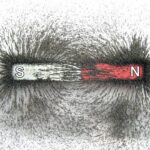 A second duality is that of polarity, meaning two antithetical points which set limits on cycles of change, such as yin and yang or above and below. Such polarities imply not rigidity nor even a pole round which cyclic movements turn, but something akin to a “magnetic field” or inter-relationship which evokes change. The two most important of these are Ch’ien (the Creative, heaven, energy, bright, yang) and K’un (the Receptive, earth, form, dark, yin).9 Wilhelm quotes the Great Commentary twice:
 “…The Book of Changes represented the gate to the whole man and to the whole world.” – Hellmut Wilhelm1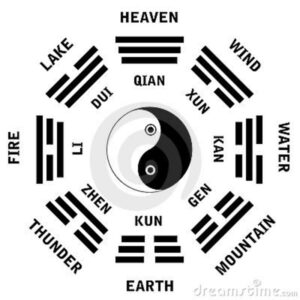
 “These peoples are superior to all other Asiatics in antiquity, art, intellect, wisdom, policy, and in their taste for philosophy…” – Diderot1
 Meanwhile, Laozi (previously Lao Tzu) was primarily a spiritual thinker, who blended a natural metaphysics with mystical experience to inform a kind of wisdom ethics centered on the value of quietism and wu-wei or effortless action. His only written work – and even that of apocryphal origin – is the very short Daodejing (historically called the Tao Te Ching). His greatest follower, Zhuangzi (previously Chuang Tzu), developed Laozi’s obscure teachings into poetic lessons more accessible to the ordinary person. Taoism had a mixed history, sometimes regional and practiced secretly when out of favor and other times state-sponsored by rulers who suppressed Confucianism and Buddhism. With the advent of the NeoConfucian amalgam, many of its metaphysical principles were accepted throughout China.


