
CULTURAL
According to Whitehead, the final level at which humans participate in ultimate reality is through our unique subset ‘organism’ within the universe – civilization. Some of his most beautiful prose describes this so I will quote liberally and perhaps excessively. He starts:
“The notion of civilization is very baffling. We all know what it means. It suggests a certain ideal for life on this earth, and this ideal includes both the individual human being and the societies of men… Yet civilization is one of those general notions that are very difficult to define…I put forward as a general definition of civilization, that a civilized society is exhibiting the five qualities of Truth, Beauty, Adventure, Art, and Peace.”18

He addresses that fifth quality in the final chapter of his last major work within which he pulls together being human with ultimacy.
“Truth, Beauty, Adventure, and Art can be ruthless, hard, cruel; and thus as the Italian Renaissance illustrates, lacking in some quality of civilization. The notions of ‘tenderness’ and ‘love’ are too narrow, important though they be…We are in a way seeking for the notion of a Harmony of Harmonies, which shall bind together the other four qualities…I choose the term ‘Peace’ for that Harmony of Harmonies which calms destructive turbulence and completes civilization.”19
Whitehead becomes very precise now:
“The Peace that is here meant is not the negative conception of anesthesia. It is a positive feeling that crowns the ‘life and motion’ of the soul. It is hard to define and difficult to speak of. It is not a hope for the future, nor is it an interest in present details. It is a broadening of feelings due to the emergence of some deep metaphysical insight, unverbalized and yet momentous in its coordination of values. Its first effect is the removal of the stress of acquisitive feelings arising from the soul’s preoccupation with itself. Thus Peace carries with it a surpassing of personality. There is an inversion of relative values. It is primarily a trust in the efficacy of Beauty. It is a sense that fineness of achievement is as it were a key unlocking treasures that the narrow nature of things would keep remote. There is thus a grasping of infinitude, an appeal beyond boundaries. Its emotional effect is the subsidence of turbulence which inhibits. More accurately, it preserves the springs of energy, and at the same time masters them for the avoidable of paralyzing distractions. The trust in the self-justification of Beauty introduces faith, where reason fails to reveal the details.”20
This kind of Peace appears spiritual yet unintentional, and as such is a ‘gift.’ It involves a high level of self-control however. The individual at peace understands the tragic nature of reality, but also of the essential place of tragedy in the creative advance. There must be both harmony and freshness in Nature, and the tragic cycle of ‘birth, culmination, and death’ is the human role in that process. Whitehead concludes,“The inner feeling belonging to this grasp of the service of tragedy is Peace – the purification of the emotions.”21
He closes this chapter exquisitely,
“At the heart of the nature of things, there are always the dream of youth and the harvest of tragedy. The Adventure of the Universe starts with the dream and reaps tragic Beauty, This is the secret of the union of Zest with Peace: – that the suffering attains its end in a Harmony of Harmonies. The immediate experience of the Final Fact, with its union of Youth and Tragedy, is the sense of Peace. In this way the World receives its persuasion towards such perfections as are possible for its diverse individual occasions.”22
Plenty to think about…
——————————————————————–
18Whitehead, Alfred North, Adventures of Ideas. The Free Press, New York, 1973. Pages 273-274. Whitehead defines the word “Adventure” as “the search for new perfections.” (Ibid., page 258). Practically this appears to mean spontaneity, originality, vigor, exploration, and at last novelty within a society which might otherwise become static or decadent through excessive complacency and conservatism.
19Ibid., pages 284-285.
20Ibid., page 285. Whitehead sounds religious or even mystical here. Once again philosophy seems to come full circle into a kind of transcendental state.
21Ibid., page 286.
22Ibid., page 296.

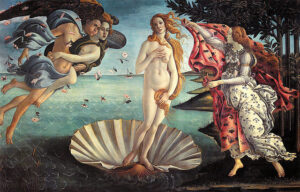 (Art it turns out is another of the five essential qualities of civilization.) Art’s purposefulness occurs by its attempt to harmonize feelings of the parts for each other and towards the whole; the resulting harmony is beautiful. And Art neglects the future in the interest of immediacy instantiating Beauty in existing reality. Art originates in a craving for re-enaction that leads to novel content which reshapes it into its final phase of satisfaction while exhausting the creative urge.17
 Moreover God’s consequent nature which originates actual occasions, such as us, completes the deficiency of God’s mere conceptual reality. The passage of actual occasions is taken up by God towards an end of perfect unity and perfect multiplicity. While we are a ‘means’:
 The pragmatic use of the actual entity, constituting its static life, lies in the future. The creature perishes and is immortal.”6 This is critical for Whitehead; doctrinally, future itself is understood “in terms of account of the process of self-completion of each individual actual occasion.”7 This objective immortality is demonstrated by repetition which is fundamental to organism.


