
 “Taoism is a religion as well as a philosophy.” – Werner Eichorn1
We move now to China with its three main ancient religious or philosophical traditions: Confucianism, Taoism2, and Buddhism. Confucius and his immediate followers were dubious of speculation on ultimate reality and God, believing that it was challenging enough to develop philosophies of human ethics and proper governance – thus they offer little for our use here. Meanwhile Buddhism originated in India and will be discussed separately in the next section. Taoism alone is both original to China and deeply concerned with ultimate reality and is thus the focus of this section.
However it is important to note that there is tremendous overlap over time in Chinese philosophy and thought. For example both Confucianism and Taoism were influenced by the earlier I-Ching and yin/yang doctrine so we will need to factor them into our evaluation. Moreover, it turns out that later in Chinese history the principles of Taoism were integrated with Confucianism (and to some extent Buddhism) under the rubric of NeoConfucianism. The reader will need to forgive me as I exercise the author’s prerogative to arbitrarily discuss all of these pieces under the general category of Taoism.3
A preliminary outline of this section follows:
- Introduction
- Historical Perspective
- The I-Ching
- Laozi (Lao Tzu)
- Zhuangzi (Chuang Tzu)
- Liezi (Lieh Tzu)
- Guo Xiang (Kuo Hsiang)
- Taoist Deities
- NeoConfucianism
- Modern Presentations
- Synopsis and Synthesis
 After this brief introduction, we will peruse the complex history surrounding Taoism in the setting of Chinese political and intellectual history. Next we will examine the I-Ching which offers an early model of ultimate reality that influenced later thinkers. Then we arrive at the core of this section; discussions on the Daodejing (known historically as the Tao Te Ching) by Laozi and the work of his follower Zhuangzi. We will add more depth with brief looks at Liezi, the third great ancient Taoist, and Guo Xiang, a later thinker. As we move forward in time we come to deification of the Tao and Huainanzi’s cosmology of the unfolding of the Tao. Thereafter we will examine briefly the integrated Chinese philosophy or religion known as NeoConfucianism which appeared in the 8th century and lasted until modern times. Finally we will look at a few contemporary presentations of Taoism for modern living. We close, as always, with a summary and synthesis.
As with the Judaism and Hinduism, our emphasis will be on ultimate reality and human participation with it as opposed to religious dogma and ritual. Join me next time as we begin with the historical perspective on the origins and development of Taoism.
—————————————–
1From Encylcopedia of the World’s Religions edited by R.C. Zaehner, page 374.
2Any writer on Chinese philosophy and religion is faced with issues of spelling, and I am no different. The current accepted spelling of ‘Taoism’ is actually ‘Daoism.’ While I will try to use modern spelling for most of this section, I prefer the older “Taoism’ for the overall subject due to its general familiarity in the West and use in many of my mostly older and even some recent sources.
3As with Hinduism, I ask for a degree of leniency from Taoist practitioners and scholars. My resources are somewhat limited and I do not claim any particular expertise in this area. My objective is only to extract the key aspects of ultimate reality found in this tradition for comparison with other religions, Western philosophy, and science. As always I am open to criticism and corrections from more knowledgeable readers and sincerely seek your comments.
—————————————–
Having trouble leaving a question or comment. E-mail me at gregoryciliberti@gmail.com
 It is experienced through ethical participation in history and civilization, in personal creation – especially art, and via the investigation and understanding of Nature, the Cosmos, humanity, and one’s inner self. It is sustained by a devotion to peace in society, and the reciprocation of virtue and caring. However, in the end, tranquil contemplation of the true nature of existence permits the deepest procurement of ultimate meaning for the philosopher.
 “Be a philosopher; but amidst all your philosophy, be still a man.” – David Hume, An Enquiry concerning Human Understanding.
 The scientific perspective distills down to pure physicalism: the opposing poles of the very small – that is what makes up the substance of the universe – and the incomprehensibly large – that is, the cosmos as a whole including its structural, dynamic, and transcendental features. Human participation occurs by means of the study of physical reality and a deep awe and near mystical understanding of existence such as Neil deGrasse Tyson’s ‘cosmic perspective’ – the reflexivity of in-ness of the universe and of ourselves and spiritual stimulus experienced in witnessing the magnificence of creation.
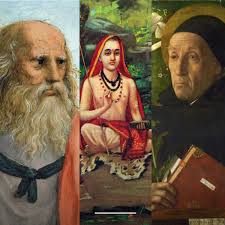 Hinduism, as much, if not more, than any other tradition locates the vertex of ultimate reality at human apotheosis – the knowledge and experience of the unity of the inner self and consciousness with the cosmic Absolute. Buddhism and perhaps the Gnostics come the closest to the equation of atman and Brahman. Christian and Sufi mystics, Plotinus, and Spinoza allow for separation but still an utter proximity or beatitude. Philosophers such as Pythagoras, Plato, and Aristotle hint of a similar state arising from contemplation and deep knowledge of oneself and the world. Science is more guarded, but we should not forget Neil deGrasse Tyson’s “great chain of being,” reflexivity of in-ness of the universe and of ourselves, and the stimulation of spirituality.
 I do not think this means we all should become Hindus or adopt all of its teachings. The philosopher must develop an individual understanding of existence and purpose. Hinduism’s takeaways are our oneness with the universe and the overlapping of individual and cosmic mind and spirit,
  Hinduism’s elevation of the idea of a law-governed universe to a key metaphysical principle corresponds better to philosophy and science than to Western religions which typically accept supernatural influences or miracles wherein God or His agents interfere with the natural course of events. The cycle of birth, life, and death (or creation, persistence, and destruction) in Hinduism takes on a more linear pattern in Western religions: compare the phrase “ashes to ashes, dust to dust” with the principle of samsara. Some scientists such as Hoyle argue the universe is eternally cyclic, but the majority of cosmologists seem to converge on a defined beginning at the Big Bang and an eventual end of the universe as a state of motionless subatomic particles (the Big Freeze). Nevertheless cosmology leaves open the possibility of a kind of cycle of recurring creativity should the hypothesis of the multiverse be true.


