
THE HIGHEST GOOD
 We seem to stray from metaphysics into ethics today as we examine the ‘Highest Good’ as presented in the Upanishads. However if the reader will bear with me, I think its place in the Hindu conception of ultimate reality will become clear.
Last time we ended with the Upanishad’s assertion that our good and evil actions due to desire or passion cause us to identify with those actions leading us away from liberation and towards further reincarnation. In short, good and bad actions of this type are counterproductive to Brahmātmaikyan (the identity of Brahman and ātman). The Westerner might be tempted to turn away from this apparent rejection of moral responsibility, but there is more to the story.
While it is true that for the Upanishads the perfect human is constrained by Knowledge rather than good and evil, this does not mean that one is free to commit sin.13 Liberation depends on the prerequisite that one eradicate all evil tendencies and devote oneself to the welfare of others. The Hindu approach to ethics, we discover, is akin to the Western system of virtue ethics, but with the emphasis on purification of the mind and deepening of the inner self. However, self-purification demands care of the body, renunciation (nyāsa), self-reflection, equanimity, detachment, and self-control.14 These then culminate in the highest good.
The Upanishads teach that evil is due to association of the self with the body and mind, while the true self is beyond pleasure, pain, righteousness, and unrighteousness.15 However that will only get one so far; the direct line to the highest good is Knowledge, that is, the Knowledge that “Brahman is the sole Reality; which appears as both the objective universe and the individual self. With this Knowledge of Brahman, the self is not lost in It; the self only realizes that it has always been Brahman.”16 So instructed we understand why ultimate reality is considered by these thinkers to be beyond categories of good and evil.
 But the circle of ultimate reality and ethics is finally closed. Moral behavior emerges from this Knowledge at it inevitably leads to universal love based on the recognition of “the fundamental oneness of all living beings.”17 And the impact is reciprocal: “The nature of Ultimate Reality, whether as Personal God or as Impersonal Absolute is Goodness, Beauty, and Truth, whose reflections are seen in their counterparts in the empirical world.”18 Nonetheless as in much of philosophy there is a paradox; the idea of ‘ought’ or morality is contrary to the struggle for perfection – you cannot be moral and perfect at the same time.19 Ethical behavior reveals the real self, but the real self is already intrinsically ethical, not moral by intention. In the end perfection means ‘God-realization’ or ‘Self-realization’ either of which transcends ‘oughts’ through freedom from the very idea of moral agency.20
So much to contemplate…
(final continuation next post)
———————————————-
13Nikhilananda, Swami, The Upanishads Volume 2. Harper & Brothers Publishers, New York, 1952. Page 1.
14Ibid., pages 4-8.
15Ibid., page 13.
16Ibid., page 17.
17Ibid., page 21. We cannot help but be reminded of Christ’s teaching.
18Ibid., page 26.
19Ibid., page 31.
20Ibid., page 33.
—————————————–
Having trouble leaving a question or comment? E-mail me at gregoryciliberti@gmail.com
 Another metaphysical principle, Karma, is explained in Chapter IV of the Brihadāranyaka Upanishad. We learn that when the body becomes weak and unconscious, the self completely withdraws from the organs and the ‘vital breath’ (soul or self) is enfolded in a new body where it reaps “the fruits of its past action.”5 This includes the knowledge and experience of the prior lifetime which “help in initiating new actions as well as bringing past work to fruition.”6
 But a key corollary metaphysical concept is not to be missed: “…the performance of good and evil deeds under the impulse of desire, anger, etc. is the cause of the ātman’s identification [with those deeds] and of its undergoing the process of rebirth. Impelled by this identification, the self takes one body after another. Therefore good and bad deeds are the cause of its rebirth.”10 However, this cycle or rebirth and death can be avoided because “…good and bad deeds prompted by desire, etc. are the cause of rebirth…When desire is absent, a deed does not lead to the accumulation of merit or demerit…desire alone is the root of transmigration.”11
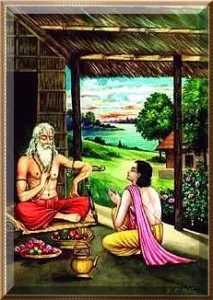
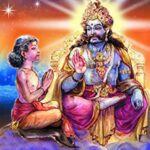 We start with the great mystery of human mortality by returning to the Katha Upanishad. Our protagonist, Nachiketas, is sent by his angry father to the House of Yama, the god of death.1 Because Nachiketas arrives while Yama is absent and waits unwelcomed for three days, Yama offers him three wishes in compensation. Nachiketas asks first for the forgiveness of his father which Yama grants. Second Nachiketas asks for the source of the secret fire by which heaven and immortality may be gained, and Yama reveals that it is found within the cavity of the heart.
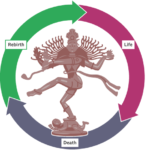 The story of Nachiketas meeting with Yama discloses the classic Hindu principles of samsara (reincarnation) and moksha (liberation) and of the existence of the human and the universal soul. It also reveals the fundamental ‘fire’ (will) in the human interior which can drive us to liberation
  The stage is now set, and we arrive at perhaps the most profound parable in the Upanishads, and perhaps in all of human literature:
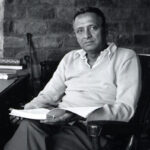 We should pause here to consider this distillate of Hindu thought. Swami Nikhilananda in the preface to his four volume translation of the Upanishads elegantly explains the significance of Brahmātmaikyan (or Brahma-ātmā – aikyam meaning ‘unity of Brahman and the ātman). It is not derived from logical argument as would occur in Western philosophy, but empirically from direct and immediate experience. It cannot be proven, but the pathway to it can be disclosed. It is both perennial philosophy and permanent knowledge, that will not and indeed cannot be refuted by future discovery. In his words:
 The great thinkers of the Upanishads start with the existence of the cyclic universe and backtrack to an originating or sustaining ‘something’ which they call Brahman.9 In the Brihadaranyaka Upanishad, Brahman is inconceivable, unchangeable, and non-injurable. The Katha Upanishad says Brahman is inaudible, invisible, indestructible, cannot be tasted or smelled, is without beginning or end, and is beyond greatness. The Mundaka Upanishad concurs, describing Brahman as:
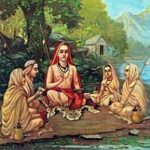 The Chandogya Upanishad retraces this pathway with the story of Prajapati instructing Indra (representing the gods) and Virocana (representing the demons) about the Self. Practicing prolonged self-discipline, Indra rejects as ultimate first the physical self as seen in a mirror (which is accepted by Virocana who quickly departs), then the dream self, and finally the dreamless self of deep sleep. At last Prajapati reveals the highest knowledge (paravidyam) that the true Self transcends the others; it is a fourth state called turiya, that of total self-consciousness and illumination.13


