
Ignorance must be overcome to end the futile life cycle of samara, and love, purity, altruism, and the ethics of dharma are prerequisites for the necessary knowledge. After this moral grounding, knowledge comes from disciplined contemplation in search of the Absolute. It turns out the Upanishads do not deny the many gods of the Vedas, but reimagine them as manifestations of the One.8 Nonetheless, as with most philosophers and mystics, the anthropomorphic solitary God is increasingly understood more abstractly.  The great thinkers of the Upanishads start with the existence of the cyclic universe and backtrack to an originating or sustaining ‘something’ which they call Brahman.9 In the Brihadaranyaka Upanishad, Brahman is inconceivable, unchangeable, and non-injurable. The Katha Upanishad says Brahman is inaudible, invisible, indestructible, cannot be tasted or smelled, is without beginning or end, and is beyond greatness. The Mundaka Upanishad concurs, describing Brahman as:
“Invisible, incomprehensible, without genealogy, colorless, without eye or ear, without hands or feet, eternal pervading all and over all, scarce knowable, that unchangeable one whom the wise regard as being womb.”10
Something remarkable happens next. Perhaps frustrated by the limits of human comprehension of the Absolute possible through contemplation of the external world, the Upanishads perform an about-face and investigate the nature of the human being effectively asking, “What am I?”11 Here they make great progress. For example, in the Taittiriya Upanishad, the various elements of the individual person are enumerated in search of that which is most basic. The matter of which one is composed is eliminated as a mere covering for bodily functions which are in turn rejected as subordinate to the mind. However even mental activity is less basic than that which gives rise to mentation – the deeper self, a “bliss of total consciousness.”12 Thus introspection becomes the means to their discovery that our fundamental essence is the inner self – that state of pure untroubled and even joyous awareness.
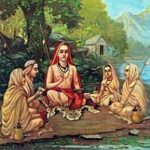 The Chandogya Upanishad retraces this pathway with the story of Prajapati instructing Indra (representing the gods) and Virocana (representing the demons) about the Self. Practicing prolonged self-discipline, Indra rejects as ultimate first the physical self as seen in a mirror (which is accepted by Virocana who quickly departs), then the dream self, and finally the dreamless self of deep sleep. At last Prajapati reveals the highest knowledge (paravidyam) that the true Self transcends the others; it is a fourth state called turiya, that of total self-consciousness and illumination.13
The Brihadaranyaka Upanishad explains that this is not the ordinary dualistic knowledge of object by subject, but more real:
“Indeed, while he does not there know, he is indeed knowing, though he does not know [what is usually to be known]; for there is no cessation of the knowing of a knower, because imperishability [as a knower]. It is not however, a second thing, other than himself and separate, which he may know.”14
(further continued next post)
————————————————
8Beck, L. Adams, The Story of Oriental Philosophy. The New Home Library, New York, 1942. Page 47.
9 We stumble into adverse ambiguity. According to Encyclopedia of the World’s Religions (page 221) Brahman is the impersonal World-Spirit, while Brahmā is the creator-god or demiurge. Brāhmana is either a sacred text or a member of the priestly caste the latter who in modern form are called Brāhman. It is not clear that all authors adhere to these distinctions however.
10Koller, John M., Oriental Philosophies. Charles Scribner’s Sons, New York, 1970. ISBN 684-13668-6, page 25. We are reminded of the via negativa, Maimonides, and the Kabbalah.
11This over 2500 years before Martin Heidegger!
12Ibid., page 26.
13Ibid., page 28.
14Ibid., page 29.
—————————————–
Having trouble leaving a question or comment? E-mail me at gregoryciliberti@gmail.com


