ULTIMATE REALITY AND THE MEANINGFUL LIFE – HINDUISM – RĀMĀNUJA (end)

THEOLOGY AND MOKSHA

Rāmānuja sees Brahman as the god of theism.10 The world was created by Brahman out of himself – His will impelling or transforming undifferentiated matter into the universe and into embodied souls (us).11 Moreover the One has personality; He created the world to satisfy His need to love and to be loved.12

Rāmānuja constructs from the Hindu texts a religion of worship and devotion. Since the devotee cannot think of the person to be worshiped as identical with himself or herself, separation and distinction are essential.13 Rāmānuja himself chose to worship the god, Vishnu.

With respect to moksha again we encounter a significant difference with Shankara. While both agree ignorance is the root cause of our bondage, for Rāmānuja, freedom from ignorance comes ideally through devotion to God (bhakti yoga), not higher knowledge (jnana yoga). The ‘work’ of this devotion includes following the rites and rituals of the Vedas (as per the Mīmāmsā texts) in accordance with one’s situation in life, done without desire or expectation of reward. Disinterested fulfillment of one’s dharma frees one from the accumulated effects of actions (karma).14

Rāmānuja teaches that we have a finite body, but an eternal, unique and real soul. The goal of human life is a permanent joining with Brahman in a state of bliss, including a degree of continued individual self-consciousness. Meanwhile the liberated self possess a suitably refined body.15 Nonetheless, this ‘salvation’ depends on God’s grace, that is, God ultimately determines each soul’s liberation.16 Because the emancipated soul is one with God, Ramanuja’s system is called ‘qualified monism.’17

Rāmānuja believes the path of devotion offers a higher bliss than Shankara’s path of knowledge. Moksha is equivalent to reaching a state where one can bask in God’s love. Rāmānuja also suggests there is a lower form of release for those who seek identity with Brahman; one of painless isolation, but this does not produce the highest happiness of communion with God.18

———————————————–

10McGreal, Ian P. (editor) Great Thinkers of the Eastern World. HarperCollinsPublishers, New York, 1995. ISBN 0-06-270085-5, page 228.

11Ibid., page 229.

12Zaehner, R.C., Encyclopedia of the World’s Religions. Barnes & Noble Books, New York, 1997. ISBN 0-76070-712-X, page 234.

13Edwards, Paul (editor), The Encyclopedia of Philosophy. Macmillan Publishing Co., Inc. & The Free Press, 1972. Vol 7, page 64.

14McGreal, Ian P. (editor) Great Thinkers of the Eastern World. HarperCollinsPublishers, New York, 1995. ISBN 0-06-270085-5, page 230.

15Edwards, Paul (editor), The Encyclopedia of Philosophy. Macmillan Publishing Co., Inc. & The Free Press, 1972. Vol 7, page 64.

16McGreal, Ian P. (editor) Great Thinkers of the Eastern World. HarperCollinsPublishers, New York, 1995. ISBN 0-06-270085-5, page 230.

17Zaehner, R.C., Encyclopedia of the World’s Religions. Barnes & Noble Books, New York, 1997. ISBN 0-76070-712-X, page 234.

18Ibid.

—————————————–

Having trouble leaving a question or comment?  E-mail me at gregoryciliberti@gmail.com
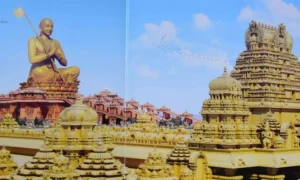
ULTIMATE REALITY AND THE MEANINGFUL LIFE – HINDUISM – RĀMĀNUJA (continued)

METAPHYSICS

Rāmānuja offers a hybrid account of metaphysics. He agrees with Shankara that reality is One, but disagrees on the nature of the One. In his view, Brahman is not distinct from the empirical world; rather the world is a constituent part of Brahman.4 He posits three factors as real: Brahman, souls, and matter. The last two are dependent on the first, but there is an inseparability (aprthaksiddhi) therein analogous to the concepts of substance and form in Western philosophy.5

We can understand Rāmānuja’s explanation of the Absolute as changeless despite its unity with a changing world by deploying the simile of the body and soul in two senses:

  1. Causal – the body serves the soul – the body is instrumental to the soul as the world is to Brahman
  2. Conceptual – they are inseparable, mutually defining – a body is of some self, and each self has a body.

Thus Brahman has a changing body (the cosmos, Nature, or prakriti, plus the many individual selves) and an unchanging Self. The individual selves are atomic (sankya), infinitesimal, or in Western parlance, ‘lack extension,’ but still have a location in the body bridged by ‘attributive intelligence’ (dharma-bhutajnana). God acts within the souls as their antaryamin or inner controller.6

Rāmānuja thinks Brahman’s attributive-intelligence pervades the universe, but what is intriguing is that he thinks this is also true of the liberated human soul…hence “tat tvam asi” (That Thou art). Thus Rāmānuja interprets this key Hindu phrase as meaning the two kinds of self are intrinsically similar (substance), while the human self is of course dependent (finite) on God (infinite).7

And so, according to Rāmānuja, all is Brahman does not mean Brahman alone exists with no attributes or characteristics; rather that every thing and every self in the world is Brahman. Brahman is not only substance in its entirety, but also all of its manifestations wherein substance alone is independently real and characteristics are a mode.8

Alternatively we might say that “The supreme Brahman is the self of all.” – the self of cosmic reality.9  Therefore, it is in consciousness and the substratum of the self where one knows the unity of reality.

(further continued next post)

—————————————–

4 Koller, John M., Oriental Philosophies. Charles Scribner’s Sons, New York, 1970. ISBN 684-13668-6, page 88.

5McGreal, Ian P. (editor) Great Thinkers of the Eastern World. HarperCollinsPublishers, New York, 1995. ISBN 0-06-270085-5, page 229.

6Edwards, Paul (editor), The Encyclopedia of Philosophy. Macmillan Publishing Co., Inc. & The Free Press, 1972. Vol 7, page 65.

7Ibid.

8Koller, John M., Oriental Philosophies. Charles Scribner’s Sons, New York, 1970. ISBN 684-13668-6, page 89.

9Ibid., pages 89-90.

—————————————–

Having trouble leaving a question or comment?  E-mail me at gregoryciliberti@gmail.com
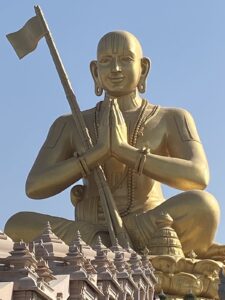
ULTIMATE REALITY AND THE MEANINGFUL LIFE – HINDUISM – RĀMĀNUJA

“No two substances resemble each other entirely and differ solo numero, in number alone.” – Gottfried Wilhelm Leibniz

On our journey to define the Hindu picture of ultimate reality we have traveled down the ancient road of the Vedas through the Upanishads, the Bhagavad Gita, and Pantanjali to a three-pronged fork in the road. The first prong took us to Shankara – the monist – for whom only Brahman truly exists, leaving everything else, including our individual selves, as mere mirage arising from flaws in our experience of the Absolute. Shankara believes illumination is found in jnana yoga or the path of knowledge, especially under the tutelage of a master.

Two centuries after Shankara, his teachings were challenged by the second of our medieval thinkers, Rāmānuja (1017?-1137?). Like Shankara, he was born into a Brahmin family, but was influenced by the ‘Identity-in-Difference’ school of Indian philosophy (Bhedābheda) and by the devotional poetry of the Tamil religious poets called the ālvārs (ones who have obtained a mystical intuitive knowledge of God).1 Rāmānuja wrote commentaries on much of the same Hindu scripture as Shankara, but came to different conclusions that he synthesized into a line of thought known as ‘qualified monism’ (viśhishtādvaita).

Rāmānuja thinks Shankara’s Brahman is too remote or abstract for human purposes, and that Shankara underestimates the value of devotion (bhakti). He also agrees with others that Shankara’s theology suffers from significant logical flaws. For instance, if the one ultimate being is perfect existence, consciousness, and bliss, then why would it manifest an illusion? Moreover if Brahman is self-conscious, then Brahman must have a personality.2

In order to understand Rāmānuja’s alternative system of qualified monism as compared to Shankara’s system of monism, we need to explore his logic, metaphysics, theology, and path to moksha.

LOGIC

Rāmānuja’s first logical point regards the concept of ‘identity.’ In his view, “pure identity is an abstract nothing.” Knowledge involves discrimination and differentiation. One cannot know an object in undifferentiated form, but only by differences in attributes which can be discriminated by the knower. Thus, identity and difference are correlative and existentially dependent on each other. To posit one without the other is nonsensical.

Rāmānja’s second point concerns the concept of ‘unity’ which he believes implies a composite of different things – consider the word ‘cosmos’ which is the aggregation of many galaxies. Identity refers to an identity of each part or galaxy while unity refers to the aggregate. Therefore, in Rāmānuja’s opinion, the unity constituting Brahman is the compilation of different selves and parts of the world. On this line of thought, identity in Hindu philosophy refers to the identity of the parts of reality in their substrata as existing.

Rāmānuja’s third point regards the inconsistency of suggesting the self is identical to knowledge. Knowledge depends on a knower and a known. The knower is the self, but the known is not.3

(continued next post)

—————————————-

1Edwards, Paul (editor), The Encyclopedia of Philosophy. Macmillan Publishing Co., Inc. & The Free Press, 1972. Vol 7, page 64.

2Zaehner, R.C., Encyclopedia of the World’s Religions. Barnes & Noble Books, New York, 1997. ISBN 0-76070-712-X, page 234.

3Koller, John M., Oriental Philosophies. Charles Scribner’s Sons, New York, 1970. ISBN 684-13668-6, page 88.

—————————————–

Having trouble leaving a question or comment?  E-mail me at gregoryciliberti@gmail.com

ULTIMATE REALITY AND THE MEANINGFUL LIFE – HINDUISM – THE CREST JEWEL OF WISDOM (continued)

“Mind is the name of the mighty tiger

that hunts in the forest glades of sensuous things;

let not the wise go thither, who seek liberation.”11

“Looking at the reflection of the sun

reflected in the water of a jar,

he who is deluded thinks it is the sun,

thus the reflected consciousness appearing under a disguise

is thought by him who is hopelessly deluded to be “I.” 12

“This all, that is perceived as the vari-form world,

from unknowledge, this all is the Eternal,

when the mind’s confusion is cast away.”13

“Every Pot and vessel has always clay as its cause,

and its material is clay;

just like this, the world is engendered by the Real,

and has the Real as its Self, the Real is its material altogether.

That Real than which there is none higher, THAT THOU ART,

the restful, the stainless, secondless Eternal, the supreme.”14

“The supreme, that no word can reach,

but that is reached by the eye of awakening, pure of stain,

the pure reality of consciousness and mind together –

this is the Eternal, THAT THOU ART; become it in the Self.”15

”The treasure of the bliss of the Eternal

is guarded by the terrible serpent of personality,

very powerful, enveloping the Self, with three fierce heads –

great sword of discernment guided by the divine teachings,

and destroying the serpent,

the wise man may enter into that joy-bringing treasure.” 16

“The first door of union is the checking of the voice,

the cessation of grasping,

freedom from expectation and longing,

the character bent ever on the one end.”17

“Firmly realizing self-hood in that,

abandoning self-hood in the selfish personality,

stand towards it as a disinterested onlooker

stands towards the fragment of a broken vase.”18

“Being verily is all this world,

that is known of voice and mind,

there is nothing else than Being,

standing on nature’s other shore.

Are cup and water-pot and jar anything but earth?

He who is deluded by the wine of glamour

Speaks of “thou” and “I.”19

“He who perceives that his soul’s pilgrimage is ended,

who is free from disunion even while possessing division,

whose imagination is free from imaginings,

he verily is called free even in life.”20

“The home of Being, the home of Consciousness,

the home of Bliss enduring, changeless;

one, verily, without a second, is the Eternal.

There is no difference at all.”21

“This is the last and final word of the teaching:

The Eternal is the individual life and the whole world;

rest in the partless One is freedom,

in the Eternal, the secondless;

and this too the scriptures show.”22

(I shall not diminish Shankara’s beautiful poetry with personal  comments.)


11Johnston, Charles (translator), The Crest-Jewel of Wisdom and other writings of Shankaracharya. The Freedom Religion Press, 2012. ISBN: 978-1-937995-99-7, page 30.

12Ibid, page 36.

13Ibid, page 37.

14Ibid, page 41.

15Ibid.

16Ibid, page  48. The three heads are selfishness, desire, and emotion.

17Ibid, page 57. The “voice” here is the inner musings of the mind.

18Ibid, page 59.

19Ibid, page 61.

20Ibid, page 66.

21Ibid, page 71.

22Ibid, page 72.

—————————————–

Having trouble leaving a question or comment?  E-mail me at gregoryciliberti@gmail.com

ULTIMATE REALITY AND THE MEANINGFUL LIFE – HINDUISM – THE CREST JEWEL OF WISDOM

“Brahma satyam, pagan mithyā, jivō brahmaiva nāparah.”1

After the detailed analysis of Shankara’s theology and philosophy presented in the last three posts, I thought the reader might like to hear from the Master himself. His great masterpiece, The Crest-Jewel of Wisdom (Vivekachudamani), is a manual of sorts for the would-be aspirant to spiritual wisdom consisting of 580 verses of poetry in stanzas of mostly three to seven lines. It is directed not to the common reader, but the “wise man.” My purpose in this and the next post is to reiterate his message in a relatively small number of poignant citations.

“Sprinkle me with thy nectar voice

that brings the joy of eternal bliss, pure and cooling,

falling on me as from a cup, like the joy of inspiration;

for I am burnt by the hot, scorching flames of the world’s fire.”2


“Fear not, wise one, there is no danger for thee,

There is a way to cross over the ocean of the world,

And by this path the sages have reached the shore.”3


“Freedom is won by a perception of the Self’s oneness

with the Eternal, and not by the doctrines of Union

or of Numbers, nor by rites and sciences.”4


“Sickness is not cured by saying “Medicine,’

but by drinking it.

So a man is not set free by the names of the Eternal

without discerning the Eternal.”5


“Those who, only for a little while rid of lust,

long to be free,

and struggle to reach the shore of the world-ocean –

the toothed beast of longing lust makes them sink half way,

seizing them by the throat, and swiftly carrying them away.”6


“Neither being nor non-being

nor of the self of both of these;

neither divided nor undivided nor of the self of both of these;

neither formed nor formless nor of the self of both of these –

very wonderful and ineffable its form.”7


“Desire, wrath, greed, vanity, malice, self-assertion,

jealousy, envy, are the terrible works of Force,

its activities in man; therefore this is the cause of bondage.”8


“Here, verily, in the substantial Self, in the hidden place

of the soul, the steady shining begins to shine like the dawn;

then the shining shines forth as the noonday sun,

making all this world to shine by its inherent light;

knower of all the changing moods of mind and inward powers;

of all the acts done by the body, powers, life-breaths;

present in them as fire in iron, strives not nor changes at all.”9

*

“Then, holding firmly the mind,

with the knowing soul at rest,

know your self within yourself face to face saying, ‘This am I.’

The life-ocean, whose waves are birth and dying, is shoreless;

cross over it, fulfilling the end of being,

resting firm in the Eternal.”10

(continued next post)

—————————————————-

1Brahman is real, the world is false, the self is not-different from Brahman.”- We are told “the entire philosophy of Shankara can be summed up in this statement” – McGreal, Ian P. (editor) Great Thinkers of the Eastern World. HarperCollinsPublishers, New York, 1995. ISBN 0-06-270085-5, page 215.

2Johnston, Charles (translator), The Crest-Jewel of Wisdom and other writings of Shankaracharya. The Freedom Religion Press, 2012. ISBN: 978-1-937995-99-7, page 12.

3Ibid.

4Ibid, page 14.

5Ibid.

6Ibid, page 17.

7Ibid., page 20. Here is Shankara’s version of the via negative seen in Western philosophy and religion.

8Ibid , page 21. Who among Westerners is not reminded of the seven deadly sins?

9Ibid., page 23. I am reminded of Plotinus (see Ultimate Reality and the Meaning of Life – Plotinus Parts I –III, dated 8/7/23 – 9/4/23 on this site).

10Ibid., page 24.

—————————————–

Having trouble leaving a question or comment?  E-mail me at gregoryciliberti@gmail.com