
We can better appreciate the importance and meaning of the Bhagavad Gita if we consider its historical and cultural context. By the middle of the last millennium B.C.E., the Upanishads were well-known to the ancient Indians, but there remained a conspicuous problem. The approach the Upanishads offered to moksha entailed a life of contemplation and withdrawal from the world, in effect, rejecting the value of human civilization and a worldly life. 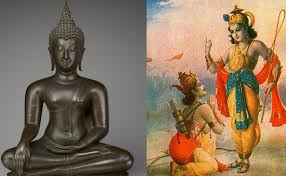 Many persons were (and still are) ill-suited to this approach, and in any case society as a whole and human survival in particular would be impossible if that approach were universally adopted. Buddhism also appeared about this time, and Hinduism needed a counter to still another seemingly society-denying dogma.
Three attitudes developed to deal with the Upanishads: (1) skepticism or disbelief, (2) acknowledgment as a hypothesis to be established by reason, and (3) acceptance as truth. The majority fell into the third category, and sought a way other than radical withdrawal and monastic discipline to comport with these teachings. The Gita offers a synthesis of the various modes available to this third group such as prayer, worship, sacrifice, and study.  It is a de facto guide on how to live life in the concrete yet also access the Absolute. Arjuna represents the everyman faced with an ethical decision, a situation experienced at one time or another by all of us. Krishna is the finite incarnation of the infinite Brahman and thus serves as a bridge – in the form of a personal deity – between human finitude and the unknowable Infinite.3
Facilitated by this contextualization, we can now make sense of what defines ultimate reality and the methods for human participation in it formulated by the Gita. Of course, the Gita is not a system of philosophical arguments per se, but I hope to extract its key principles in the upcoming posts following the outline below:
- Metaphysics
- God
- The Psychology of the Human Mind
- Ethics and Ultimate Reality
- Synthesis
Join me next time as we start with the Gita’s metaphysical propositions.
———————————————————————————————
3Koller, John M., Oriental Philosophies. Charles Scribner’s Sons, New York, 1970. ISBN 684-13668-6, pages 33-37.
 “I owed a magnificent day to the Bhagavad Gita. It was the first of books; it was as if an empire spoke to us, nothing small or unworthy, but large, serene, consistent, the voice of an old intelligence which in another age and climate had pondered and thus disposed of the same questions which exercise us.” – Ralph Waldo Emerson
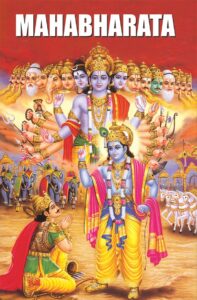 The Bhagavad Gita is usually published as a free-standing text, but in fact makes up 700 verses contained in (or inserted as) chapters 23-40 of Book 6 (titled Bhishma) of the 18 books that comprise the Mahabharata.1 This epic takes place in India at least 1000 years B.C.E., although the Bhagavad Gita was probably written between 400 and 100 years B.C.E. – that is, after the Upanishads. The setting of the story is the battlefield of Kurukshetra where the virtuous Pandava brothers lead an army against the legions of their evil half-brothers who have denied them rightful rule over their kingdom. Arjuna is the eldest brother and greatest warrior of the Pandavas and tasked with leading them into battle. However, at the beginning of the battle, he hesitates with initiating this internecine carnage and seeks counsel on the ethics of his choices from his charioteer and friend, Krishna, the avatar of God. The bulk of the poem then is the philosophical and theological teachings offered by Krishna.2
 Karma appears to be the most scientifically, philosophically, and subjectively consistent truth of the Upanishads. The Western scientist may see it as a formulation of cause and effect or determinism. The philosopher may classify it with fate, but also as the underpinning of ethics wherein freely made choices involve both predictable and unforeseeable consequences imposing an obligation of thoughtful deliberation. Subjectively, most of us have experienced the sense of unexpected after-effects, delayed justice, or echoed retribution relating to our prior actions.
 It seems to me the Upanishads make more sense if we amplify the meaning of Knowledge as the Highest Good beyond “Tat Tvam Asi” to other philosophical truths. For instance compare a vaguely similar description of our distinctive knowledge as humans that I presented in an earlier section:5
 However if we can reach down to it, we intuit its co-extensiveness (although perhaps not identity) to the whole of reality and the universe. This is how I interpret ātman = Brahman. Meanwhile the scientist might note that the subatomic particles that make up a person and the natural laws that apply to that person are the same as those of all physical entities, again confirming a kind of oneness of humans and the cosmos.
 However, I see three metaphorical interpretations of reincarnation for the philosopher’s consideration. First it can be seen as the phases of a single life. Given the length of modern human life, many of the immaterial aspects of a person (the ‘soul’) change under the influence of experience and environmental changes. Reincarnation can also be recast as the passing of our genes to our offspring or of learned values, prosperity, and intellectual advancement to our offspring and to future generations. Last, human reverberations within the universe occur via the recycling of our material make-up and the chains of causation we initiate.
 “He who has not understanding, who is unmindful and ever impure, reaches not the goal, but goes on to transmigration. He, however, who has understanding, who is mindful and ever pure, reaches the goal from which he is born no more.” – Katha Upanishad1
 The Hindu notion of Brahman as the entirety of reality, the World Soul, and a divine being is mirrored in the scientific and Western philosophical notions of the cosmos (arguably a human construct). Neither the scientist nor the philosopher can prove the universe has consciousness (much less a soul), but then neither can this be definitively refuted. Consciousness and will remain mysterious even to those of us who have it and there remains no final test of its existence outside oneself, so we simply cannot know either way. The strict scientist and positivist philosopher may consider untestable theories as nonsense, but on the other hand, many individuals claim to experience a kind of mental immanence from the cosmos, an experience which remains unexplained.
 Having examined in this second part on the Upanishads the meaning of samsara, moksha, karma, and the Highest Good, we have this last remaining nuance of ultimate reality for discussion. The Chhāndogya Upanishad begins with the Ugditha a hymn beginning with the word ‘Om’ (or ‘Aum’) which is in fact identical to the Ugditha. This hymn discloses “the greatness and power of Om, the essence of all things…and the principal prana, or the vital breath.”21 Om “is the most sacred word of the Vedas and symbol of both the Personal God and the Absolute.”22
 Before I close this post, I offer one last truly remarkable chant from the Chhāndogya Upanishad that sums up its synthesis of Brahman and Om:


