
 “I owed a magnificent day to the Bhagavad Gita. It was the first of books; it was as if an empire spoke to us, nothing small or unworthy, but large, serene, consistent, the voice of an old intelligence which in another age and climate had pondered and thus disposed of the same questions which exercise us.” – Ralph Waldo Emerson
In the first two segments of this section on Hinduism, we examined ultimate reality as presented in the Vedas and the Upanishads. The key contribution of the Vedas is the description of the highest (and finally singular) deity, a God of goodness who has created a unity of thought and essence among all living beings and who provides for the needs of his creatures. The Upanishads amplify the divine and add other metaphysical features: (1) the eternal cosmic rhythm of Creation, Maintenance, and Dissolution, (2) Brahman – the universal spirit – which manifests as a tripartite deity, (3) Âtman – our deepest inner self, (4) Samsara (reincarnation) and moksha (liberation from rebirth), (5) the eternal fire within the human heart – will and unenlightened desire, (6) Karma – actions and their consequences, (7) the Highest Good – Knowledge (especially of the unity of Brahman and ātman), and (8) “Om” (or “Aum”) – the sacred sound which symbolizes God (the Absolute), and is the optimal focus for meditation.
Today we look at perhaps the most sacred text in Hinduism and one of the most precious texts in human history, the Bhagavad Gita (“Song of the Lord”). Because of its importance, because it is in Sanskrit and thus open to varying translations, and because it admits to myriad levels of interpretation, I will consult six different sources as we delve into its presentation of ultimate reality.
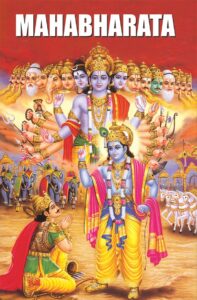 The Bhagavad Gita is usually published as a free-standing text, but in fact makes up 700 verses contained in (or inserted as) chapters 23-40 of Book 6 (titled Bhishma) of the 18 books that comprise the Mahabharata.1 This epic takes place in India at least 1000 years B.C.E., although the Bhagavad Gita was probably written between 400 and 100 years B.C.E. – that is, after the Upanishads. The setting of the story is the battlefield of Kurukshetra where the virtuous Pandava brothers lead an army against the legions of their evil half-brothers who have denied them rightful rule over their kingdom. Arjuna is the eldest brother and greatest warrior of the Pandavas and tasked with leading them into battle. However, at the beginning of the battle, he hesitates with initiating this internecine carnage and seeks counsel on the ethics of his choices from his charioteer and friend, Krishna, the avatar of God. The bulk of the poem then is the philosophical and theological teachings offered by Krishna.2
(continued next post)
———————————————————————————————
1The Mahabharata is a vast epic of unknown authorship (likely multiple authors) that is twelve times the length of the Iliad and the Odyssey combined and longer than the New and Old Testaments together. It is foundational to Indian culture in the same way those volumes are foundational to Western culture.
2The title “Song of the Lord” does not refer to a song in praise of God, but rather to the revelation expressed in the words of the incarnate deity.


