
We can better appreciate the importance and meaning of the Bhagavad Gita if we consider its historical and cultural context. By the middle of the last millennium B.C.E., the Upanishads were well-known to the ancient Indians, but there remained a conspicuous problem. The approach the Upanishads offered to moksha entailed a life of contemplation and withdrawal from the world, in effect, rejecting the value of human civilization and a worldly life. 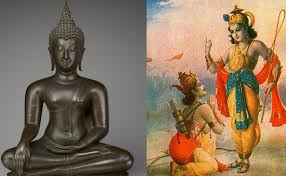 Many persons were (and still are) ill-suited to this approach, and in any case society as a whole and human survival in particular would be impossible if that approach were universally adopted. Buddhism also appeared about this time, and Hinduism needed a counter to still another seemingly society-denying dogma.
Three attitudes developed to deal with the Upanishads: (1) skepticism or disbelief, (2) acknowledgment as a hypothesis to be established by reason, and (3) acceptance as truth. The majority fell into the third category, and sought a way other than radical withdrawal and monastic discipline to comport with these teachings. The Gita offers a synthesis of the various modes available to this third group such as prayer, worship, sacrifice, and study.  It is a de facto guide on how to live life in the concrete yet also access the Absolute. Arjuna represents the everyman faced with an ethical decision, a situation experienced at one time or another by all of us. Krishna is the finite incarnation of the infinite Brahman and thus serves as a bridge – in the form of a personal deity – between human finitude and the unknowable Infinite.3
Facilitated by this contextualization, we can now make sense of what defines ultimate reality and the methods for human participation in it formulated by the Gita. Of course, the Gita is not a system of philosophical arguments per se, but I hope to extract its key principles in the upcoming posts following the outline below:
- Metaphysics
- God
- The Psychology of the Human Mind
- Ethics and Ultimate Reality
- Synthesis
Join me next time as we start with the Gita’s metaphysical propositions.
———————————————————————————————
3Koller, John M., Oriental Philosophies. Charles Scribner’s Sons, New York, 1970. ISBN 684-13668-6, pages 33-37.


