
 “We behold what we are, and we are what we behold.” – Jan van Ruysbroeck.
In the last two posts I provided some introductory background and context regarding the Bhagavad Gita. We will now attempt to extract the elements of ultimate reality from its account, beginning with its leading metaphysical positions. The reader should not be surprised at some repetition of the principles conveyed in the last segment as the Gita echoes much in the Upanishads, although from a more practicable perspective.
First, the pinnacle of ultimate reality is reaffirmed as Brahman. The physical world and its parts are in constant flux, but ultimate reality is absolute, eternal, unchanging, and finally impenetrable. For example in the second Chapter, Krishna tells the reluctant Arjuna:
“…THAT which pervades the Universe is imperishable. None can destroy that Changeless One. It is the bodies of the Everlasting, Incomprehensible, Body-Dweller which [only] have an end.”1
This quote also incorporates a second key metaphysical point: atman, the inner self, is co-substantial with Brahman, the universal spirit. Thus the body and the outer self are the transmigrating jiva (living being or soul) while the real self is the undying atman, that is, the observer not the doer, a situation mirrored by Brahman and the universe as well.2 Alternatively we can see Brahman as God transcendent and Atman as God immanent a concept known as advaita (not two).3
Third, reality is ‘non-dual’ because the personified absolute being is the foundation of all beings (both matter and mind). Instead the world we perceive is maya or the illusion of multiplicity, not ultimate reality itself.4 The technical Sanskrit terms are Purusha (pure spirit, atman, or Self) and prakriti ( nature and the phenomenologic world).
Fourth every worldly object including human beings is a compound of three gunas or qualities: (1) sattva (goodness, harmony, purity, or clarity), (2) rajas (passion or energy), and (3) tamas (darkness, ignorance, or inertia). Each individual’s ‘guna mix’ determines their temperament or character and defines to some extent their dharma. Krishna tells us:
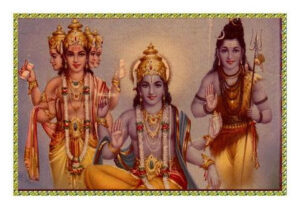 “My womb is prakriti; in that I place the seed. Thus all created things are born…It is the three gunas born of prakriti – sattva, rajas, and tamas – that bind the immortal Self to the body. Sattva – pure, luminous, and free from sorrow – binds us with attachment to happiness and wisdom. Rajas is passion arising from selfish desire and attachment. These bind the self with compulsive action. Tamas, born of ignorance, deludes all creatures through heedlessness, indolence, and sleep.”5
The last key metaphysical concept references freedom. It turns out that karma undermines human free will, subjecting all of us to a kind of predestination. Instead true freedom (the highest level of free will) comes via moksha.6 Still freedom does not lie in renunciation of the world but disciplined action.7 Arjuna learns this as he experiences first an elevated state of consciousness, then an inner state of transcendence, and finally a state of eternal freedom in which he can love God and all beings.8
———————————————————
1Beck, L. Adams, The Story of Oriental Philosophy. The New Home Library, New York, 1942. Page 112. An alternative translation from Barbara Stoler Miller’s The Bhagavad Gita, Quality Paperback Book Club, New York, 1998. Page 31-32 (Bhagavad Gita 2:17-18):
“Indestructible is the presence that pervades all this; no one can destroy this unchanging reality. Our bodies are known to end, but the embodied self is enduring, indestructible, and immeasurable…”
2 McGreal, Ian P. (editor) Great Thinkers of the Eastern World. HarperCollinsPublishers, New York, 1995. ISBN 0-06-270085-5, pages 176-177.
3Easwaran, Eknath (translator) The Bhagavad Gita. Nilgiri Press, California., 2007. ISBN 978-1-58638-019-9, page 26.
4Ibid., p. 27. Easwaran believes this fits well with modern physics: “…the world of ‘name and form’ exists only as a condition of perception; at the subatomic level, separate phenomena dissolve into a flux of energy The effect of maya is similar. The world of the senses is real, but it must be known for what it is: unity appearing as multiplicity.” (Page 29.)
5Ibid., p. 224-225 (Bhagavad Gita 14:3-8).
6Magill, Frank N. and McGreal, Ian P. (editors), Masterpieces of World Philosophy. HarperCollinsPublishers, 1990. ISBN 0-06-270051-0, page 14. (This from their summary of Eliot Deutsch’s interpretation of the Gita).
7Miller, Barbara Stoler (translator), The Bhagavad Gita, Quality Paperback Book Club, New York, 1998. Page 8.
8Schweig, Graham M. (translator), Bhagavad Gita. HarperOne, New York, 2007. ISBN 978-0-06-199730-3, page10.


