
‘CATEGOREAL’ SCHEME
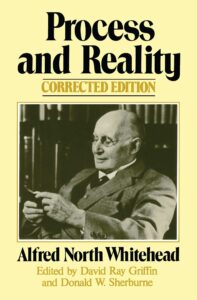 Whitehead believes that philosophy serves to explain the abstractions that we develop from our interaction with the concrete world. These abstractions originate from a framework of “generic notions inevitably presupposed in our reflective experience,”5 specifically actual entities, prehensions (cogitation or ideas), ‘nexūs’ (plural of nexus – involvement of actual entities with each other through prehension), and ontological principles.6 This intuitive base leads to his second major philosophical principle: we bring the abstract and the concrete together using a ‘categoreal’ scheme comprised of four categories: (1) Categories of the Ultimate (creativity), (2) Categories of Existence (eight items), (3) Categorical Explanations (twenty-seven items), and (4) Categorical Obligations (nine items).7
The foundations of reality are the categories of existence: (1) actual entities (particular substances), (2) prehensions, (3) nexūs, (4) subjective forms, (5) external objects, (6) propositions, (7) multiplicities, and (8) contrasts (opposites). Of these, most important are actual entities which include living and nonliving things, humans and God.  Actual entities, also termed ‘actual occasions’ (exclusive of God – more on this to follow), are the building blocks of the organic universe making them the ultimate facts. They are in a continuous process of becoming and perishing, but taken up in the creative advance. Because actual entities also pass into other actual entities through prehension, a kind of immortality is realized by all actual entities.8
A set of actual occasions in a unity of relatedness constituted by reciprocal prehensions leads to a nexus. Nexūs are thus societies of actual occasions that grow together through a process of integration of prehensions or feelings to a final phase he calls “satisfaction” or “concrescence.” Throughout this process is reflected two key doctrines: (1) the doctrine of self-constituting identity wherein each actual entity identifies itself as an individual constituent, and (2) the doctrine of cosmic order wherein all prehensions contribute to a pre-established universal harmony.9
GOD
There is one exceptional actual entity, God, which (who?) alone is not occasioned by something else – i.e. God is an actual entity but not an actual occasion, but a (the) primordial fact lacking temporality. However, God has two natures, first as the primordial entity, the actual entity which envisages all eternal objects and the appertition for their actualization.10 Eternal objects are pure potentials and neutral within the temporal order. They are permanent, immutable, principles of determination fixed in the primordial vision of God. They are the structure of the organismic process in which process and structure are interdependent.
God’s second nature, consequent nature, wherein is God transmutes eternal potentials into each and every concrete actual entity or occasion through divine wisdom. God shares in the fullness of the physical feelings of the world as a conscious entity and God’s relation to the world, according to Whitehead, is one of love and care tending to the preservation of all. In part then God is “the great companion, the fellow sufferer who understands.” Nonetheless, Whitehead is clear, God is a part of the system and thus subordinate to the category of the ultimate.11
(further continued next post)
———————————————————-
5Alfred North Whitehead in Process and Reality. The Free Press, New York, 1978. ISBN 0-02-934570-7, page 18.
6Ibid.
7 Magill, Frank N. and McGreal, Ian P. (editors), Masterpieces of World Philosophy in Summary Form. Harper & Row, Publishers, New York, 1961. Page 923.
8Ibid., pages 923-924.
9Ibid., page 924.
10Ibid.
11Ibid.
 In our quest for a comprehensive philosophical understanding of ultimate reality we have reviewed the ancient Greek and Hellenic sages and our first four modern thinkers: Spinoza, Kant, Hegel, and Schopenhauer.2 We come now to our last major modern philosopher who describes a vision of the ultimate nature of reality, the twentieth century philosopher, Alfred North Whitehead. Whitehead’s interpretation, although remarkably complex, can be distilled to a single word – organism – by which he means the universe is ultimately a unity, not a multiplicity; a process, not a state; a becoming, not a being. He lines up with Heraclitus, Plato, and Leibniz, in contrast to Parmenides, Aristotle, and Descartes.
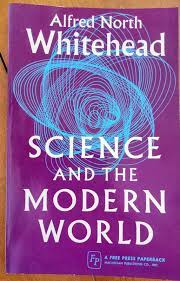 In his essay, Science and Philosophy,3 Whitehead offers the starting point for understanding his system. He begins contextually; whereas science seeks to understand the stark particulars of reality and disregards or denies meaning, philosophers seek to explain universal principles and mutual references, eliminate arbitrariness, and demand meaning. Traditionally ancient philosophers focused on the “drama of the universe” while modern thinkers emphasize the “inward drama of the soul,” but Whitehead wants to revert to the former.
 However, Schopenhauer reserves his highest regard for music which in his words “is as direct an objectification and copy of the whole will as the world itself, nay, even as Ideas, whose multiplied manifestation constitutes the world of individual things. Music is thus by no means like the other arts, the copy of the Ideas, but the copy of the will itself, whose objectivity the Ideas are. This is why the effect of music is so much more powerful and penetrating than that of the other arts, for they speak only of shadows, but it speaks of the thing itself. Since, however, it is the same will which objectifies itself both in the Ideas and in music, though in quite different ways, there must be, not indeed a direct likeness, but yet a parallel, and analogy, between music and the Ideas whose manifestation in multiplicity and incompleteness is the visible world.”11
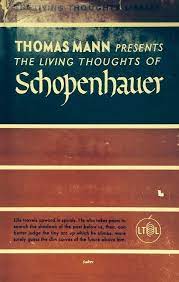 Last time I discussed how ultimate reality for Schopenhauer is Will and also that the world is an Idea arising within the human mind. Schopenhauer is, for many, the greatest philosophical pessimist in history because on his account: the all-controlling Will is a purposeless, striving and yearning without rhyme or reason. It is insatiable or only briefly satiable, and is seemingly inescapable. Free will then can be reduced to the dubious freedom to suffer from an unquenchable will.
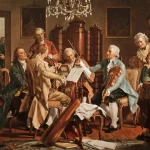 This is most demonstrable in ‘the aesthetic state’ because aesthetic gratification is pure and leads us to the Ideas. Art, by the genuine artist, and perhaps Beauty in general, is as Kant taught us, “what happens without interest (Schopenhauer thinks this means ‘without reference to the will’). By concentration on the aesthetic we can reach “a state of selfless resignation, where reference was [is] to things as sheer ideas, no longer as purposes; and a peace…the painless state praised by Epicurus.”6 And finally, Schopenhauer believes the most pure of all art is music and therein may be the greatest escape available.


