
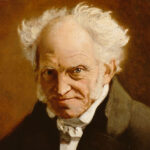
 “In the whole world there is no study so beneficial and elevating as that of the Upanishads. It has been the solace of my life. It will be the solace of my death.” – Arthur Schopenhauer1
————–
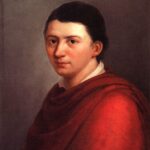 “Even the loftiest philosophy of the Europeans, the idealism of reason as set forth by the Greek philosophers, appears in comparison with the abundant life and vigor of oriental idealism like a feeble Promethean spark against the full flood of sunlight. It is faltering, weak, and ever ready to be extinguished. What distinguishes the Vedanta from all other philosophies is that it is at once religion and philosophy. In India the two are inseparable.” – Friedrich Shlegel.2
Last time we examined the earliest religious texts of ancient India, the Vedas, noting that their initial polytheism and superstition gave way to a near monotheism and divine ethics. I closed by noting the successor texts, known as the Upanishads, present some of the most fascinating philosophy in human history. The two epigraphs above are my attempt to dissuade the reader from thinking this mere hyperbole. Clearly philosophers of far greater standing than me have appreciated the sublime thought which I hope to precís in these next series of posts.
It is impossible to know when the Upanishads appeared, but it was after the Aryan invasion and most authorities believe they were written starting circa 800 B.C.E. and continued until at least the time of the Buddha perhaps 300 years later. There are ten chief Upanishads and their authorship is unknown.3 Their conclusions are often restated in aphorisms known as Sutras (literally ‘threads’)4
 In opposition to Greek philosophy, the Upanishads deny that the life and consciousness of man is bound by logical reason. Self-consciousness is limited and ultimately bedazzled by super-consciousness (mystic experience?), which is the optimal means to perceive the fundamental order of the universe. The utmost reach of this thought is the basis for the six divisions within Indian philosophy.5
However there is general agreement on an eternal cosmic rhythm of Creation, Maintenance, and Dissolution. The eternal Brahma meditating in darkness brings about the Thought by which the universe proceeds. Later thinkers attribute this cycle to a divine Trinity: Brahma the creator, Vishnu the Maintainer, and Shiva the Destroyer.6 Each cosmic cycle ends in a‘Night of Brahma’ after which a refashioned universe emerges in a process of continual evolution. This same process is mirrored in the cycle of human life where reincarnation progressing through the ‘baptism of death’ brings about evolution of the soul. Consider the Kartha Upanishad:
“Never the spirit was born; the spirit shall cease to be never.
Never was time it was not. End and beginning are dreams.
Deathless and birthless and changeless abideth the spirit forever.
Death cannot touch it at all, dead though the house of it seems.”7
(continued next post)
————————————————
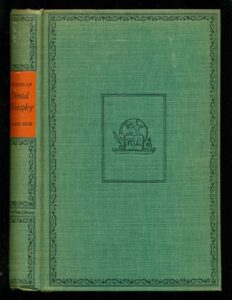
1Beck, L. Adams, The Story of Oriental Philosophy. The New Home Library, New York, 1942. Page 42.
2Ibid.
3Ibid.
4Ibid., page 43
5Ibid., page 44. Space and time prevent me from going into depth on the different divisions. Interested readers may check out The Encyclopedia of Philosophy Volume 4 pages 155-160.
6Ibid., page 44-45.
7Ibid., page 46. The western philosopher should remember that reincarnation was also a fundamental belief of both Pythagoras and Plato.
—————————————–
Having trouble leaving a question or comment? E-mail me at gregoryciliberti@gmail.com


