
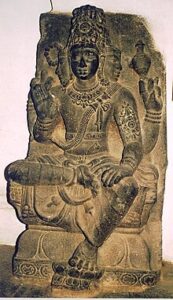
 The Rig Veda is the oldest of the Vedas and considered the most important as it poses the great questions of existence, creation, and death. It consists of 1028 hymns in about 10,000 stanzas full of wonder, awe, and humility. The source of creation is at first unclear (see epigraph last post), but later attributed to a personal creator, Prajapati, who self-divided to bring about the sky, earth, sun, air, and wind. The thirty-three gods were created at this time as well. One special god is Indra who protects the ancient Indians in battle, not unlike Jehovah in the Hebrew tradition.
In the Rig Veda life after death is ambiguous at best; Yama is the ruler of the mysterious place where all the dead are destined to go whether their life has been good or evil, and reincarnation is not yet assumed.8 Only later does polytheism wane and transmigration of the soul appear. It is also worth noting that the Vedas predate the caste system.
We can appreciate some of the quality of ethics in the Vedas with a few passages starting with this:
“If we have sinned against the man who loves us, have
ever wronged a brother, friend, or comrade,
The neighbor ever with us, or a stranger, O Varuna,
remove from us this trespass.
If we, as gamesters cheat at play, have cheated, done
wrong unwittingly or sinned of purpose,
Cast all these sins away like loosened fetters, and,
Varuna, let us be thine own beloved.”9
I am reminded of the Our Father of the New Testament. Here is another stanza:
“Let the rich satisfy the poor implorer, and bend his
eye upon a longer pathway.
Riches come now to one, now to another, and like the
wheels of cars are ever rolling.”10
We are reminded of Christian charity – a millennium before Jesus! I also think of Boethius and the wheel of fortune. One last citation with a more metaphysical leaning:
“Prajapati engenders earthly creatures: may the
benevolent ordainer form them,
Having one common womb, and mind, and spirit. He
who is lord of plenty give me plenty!”11
The now seemingly singular highest deity is a god of goodness who (it is hoped) has created a unity of thought and essence among all living beings and who provides for the needs of his creatures.
 The Vedas represent the nascent beliefs of an evolving culture and yet clearly begin a process of questioning, reflection, and ethical awareness. The stage is set for the Vendata (‘the End of the Vedas’) – or post-Vedic thought expressed in the Upanishads. We pick up there next time – join me for some of the most fascinating philosophy in human history.
—————————————————-
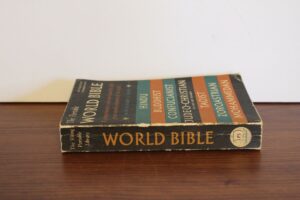
8Ballou, Robert O., The Viking Portable Library World Bible. The Viking Press, New York, 1966. Page 23.
9Ballou, Robert O., The Viking Portable Library World Bible. The Viking Press, New York, 1966. Page 34 (from the Rig Veda).
10Ibid., page 36 (also from the Rig Veda).
11Ibid., page 37 (from the Atharva Veda).


