
“The living come from the dead, just as the dead come from the living.” – Plato, Phaedo.
In the first part of this section we saw that for Upanishads, ultimate reality consists of three elements: (1) the eternal cosmic rhythm of Creation, Maintenance, and Dissolution, (2) Brahman, the universal spirit (possibly manifesting as three demiurges – Brahma the Creator, Vishnu the Maintainer, and Shiva the Destroyer), and (3) atman – our deepest inner self. We also learned that the great discovery of the Upanishads was the equation: atman = Brahman. Today we turn to a few additional metaphysical teachings of the Upanishads in order to round out our understanding.
SAMSARA AND MOKSHA
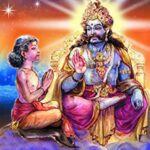 We start with the great mystery of human mortality by returning to the Katha Upanishad. Our protagonist, Nachiketas, is sent by his angry father to the House of Yama, the god of death.1 Because Nachiketas arrives while Yama is absent and waits unwelcomed for three days, Yama offers him three wishes in compensation. Nachiketas asks first for the forgiveness of his father which Yama grants. Second Nachiketas asks for the source of the secret fire by which heaven and immortality may be gained, and Yama reveals that it is found within the cavity of the heart.
Third Nachiketas asks to know the state of the soul after death. Yama resists, offering him instead wealth, a kingdom, and endless pleasures, but Nachiketas declines remarking that worldly goods are ultimately fleeting.2 Yama congratulates Nachiketas for correctly distinguishing the true good from the merely desirable. Pleasure and wealth, we learn, are the paths on which many perish while the pursuit of knowledge and truth is the sole worthwhile objective of human kind.
Yama tells Nachiketas that the seeker of truth eventually finds the most subtle of mysteries, the Soul:
“The soul is not born and does not die. It is not produced from anyone nor does it produce. It is unborn, eternal, timeless, ancient. It is not slain when the body is slain… The Self that lodges in the heart of each man is smaller than the small, greater than the great. The man whose will is at rest sees Him and freed from sorrow; through serenity of the senses he sees the glory of the Self…He is bodiless yet dwells in things incarnate. He is permanent yet dwells in things impermanent. He is the All-Pervading. Know the embodied soul is the rider, the body is the car, intellect is the charioteer, and mind is the reins…If a man is without wisdom and impure, he does not attain to his Home but goes on the road of birth and death. If a man has wisdom he attains that Home from which he does not return again to birth.”3
Yama concludes:
“Higher than the senses are their objects, higher than these objects is the mind, higher than the mind is Intelligence. Higher than Intelligence is the Great Self. Higher than the Great Self is the Unmanifested. Higher that the Unmanifested is the Soul. Higher than the Soul is nothing, That is the goal… he who has understood the Nature of Brahm [the Universal Self] is freed from death.”4
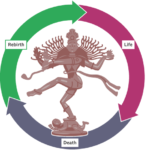 The story of Nachiketas meeting with Yama discloses the classic Hindu principles of samsara (reincarnation) and moksha (liberation) and of the existence of the human and the universal soul. It also reveals the fundamental ‘fire’ (will) in the human interior which can drive us to liberation and the supremacy of truth over other human cravings.
(continued next post)
—————————————-
1Beck, L. Adams, The Story of Oriental Philosophy. The New Home Library, New York, 1942. Pages 53-57.
2The Westerner may be reminded of the choice of Solomon for wisdom in the Old Testament.
3Ibid., page 56.
4Ibid.
—————————————–
Having trouble leaving a question or comment? E-mail me at gregoryciliberti@gmail.com


