
 “…The Book of Changes represented the gate to the whole man and to the whole world.” – Hellmut Wilhelm1
The I Ching (AKA the Yi jing or the Zhou-Yi, the Changes of Zhou) was both originally a divination manual (akin to Tarot cards in the West) and “almost the only important work of metaphysics”2 in early Chinese history. Its earliest origin goes back to Fu Hsi (or Fu Xi – his dates 2852-2737 B.C.E.), a legendary emperor, who invented the eight Kua or mystic triagrams that symbolize the laws and elements of nature. Each Kua consists of 3 lines, either continuous, representing yang (male, positive, active, productive, celestial, light, heat, life) or broken representing yin (female, negative, passive, earthy, dark, cold, death). From this earliest framework, we infer a metaphysics based on a mystical dualism of opposites resting upon a foundation of naturalism.
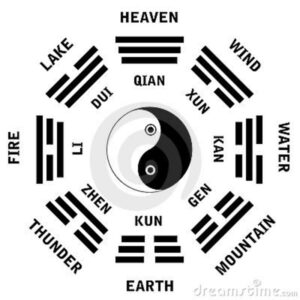
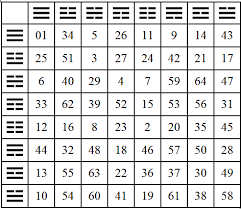
Some 1700 years later the original Book of Changes was composed by the imprisoned Ji Ch’ang (later the founding monarch of the Zhou or Chou dynasty circa 1027 B.C.E., and thus also known as King Wen). He stacked each triagram on top of itself and on top of each of the other triagrams to create 64 hexagrams (hsiangs) that further amplified the laws underpinning nature. His son. Ji Dan (Chi Tan) refined these and composed initial statements. Later thinkers, possibly including Confucius, wrote commentaries (e.g. the “Ten Wings”) based on their study of the hexagrams, thereby converting the text from a tool of prognostication into philosophy. It reached its ‘final’ canonical form under the title Yi Jing in 136 B.C.E.
Philosophically, the I Ching offers at the most basic level both a model of the cosmos and a guide to the relations of human beings with respect to the continuous change within reality and the universal interplay of opposing natural forces – yin and yang.3 As such, it can be integrated into ethics and politics (Confucianism) or cosmology and metaphysics (Taosim). It is not inherently dark, mysterious, or abstruse, rather “the easy, the simple, the naturally given.”4 That is to say, everyone empirically recognizes the fundamental principle of reality is continuous change, especially movement that returns to its starting point such as day and night, the seasons, the cycle of birth and death, and so forth.
But change in the I Ching references not any and all movement as its opposite is not rest or absence of motion, but instead reverse movement – i.e regression, life’s reversal, it’s perversion. Critically, change is not an external force, but an inner tendency to natural and spontaneous development. It is also multidimensional. In the end, humans do best to acquiesce to the changes of natural movement and growth and ride it at the individual and societal levels.
Hellmut Wilhelm tells us how this is metaphysically possible:
“The fact that the movement returns to its starting point keeps it from dispersing, which movement in one dimension only cannot prevent. The infinite is thus brought within the confines of the finite, where alone it can be of service to man.”5
(continued next post)
———————————————
1Wilhelm, Hellmut, Change – Eight Lectures on the I Ching. Princeton University Press, Princeton New Jersey, 1973. ISBN 0-691-01787-5, page ix. Wilhelm was one of a group of German-speaking ex-patriots living in Peking during the Japanese occupation. He made 8 lectures on the I Ching to other exiles at the home of Wilhelm Haas at Haas’s suggestion in the winter of 1943.
2Durant, Will, Our Oriental Heritage. Simon and Schuster, New York, 1963. ISBN0-671-54800-X, page 650. It is this second understanding of the text we are addressing here.
3McGreal, Ian P. (editor) Great Thinkers of the Eastern World. HarperCollinsPublishers, New York, 1995. ISBN 0-06-270085-5, page 60.
4Wilhelm, Hellmut, Change – Eight Lectures on the I Ching. Princeton University Press, Princeton New Jersey, 1973. ISBN 0-691-01787-5, page 16.
5Ibid., page 20.
—————————————–
Having trouble leaving a question or comment? E-mail me at gregoryciliberti@gmail.com


