
In the last post I summarized an essay/lecture by Jacques Barzun from 1969 on the question of whether life is worth living. Today I will add some of my thoughts on his thesis and its application to our time.
I agree that we have difficulty separating feelings which are visceral from thoughts which presumably rely on reason. With so little in philosophy being certain, feelings and opinion become inescapable default criteria in the reasoning process. Barzun’s belief that life for each of us is experienced individually rephrases a basic tenet of existentialism which when paired with Martin Heidegger’s observation that the self (or dasein) experiences itself as being-in-the-world, reinforces Barzun’s concern of society’s impact on the quality of our lives. But if we can only find meaning and happiness as individuals, society should be structured for every individual to succeed.
What is it about life that makes us wonder if it is worth living? Perhaps the answer is found in Buddha’s first noble truth; “Life is suffering.” In return for that suffering, man expects certain benefits – specifically the hope of happiness and meaning. Personal limitations, natural ills, and death can be accepted as unavoidable, but we seem unable to forgive the evils of the very society we created. For instance manners may appear superficial, restrictive, and inconvenient, but in fact Barzun, like Confucius, knows better – manners and respect for others is essential to their contentment. Immanuel Kant expands this into his categorical imperative: we must never treat another as a means, only as an end.
Meaningful work is tied closely to the need for individual purpose in the achievement of happiness. Here I wonder if Barzun is being completely objective; the agrarian life of our ancestors seems no more meaningful than modern livelihoods. Nonetheless it is undeniable that finding societal purpose through one’s vocation is a critical piece of a flourishing life.
With regards to democracy and capitalism, they appear to allow the highest quality of life possible so far, but the negative consequences of materialism and futile competition are a trap that stymies fulfillment. In a world where the competition for physical survival is muted, we must be reminded frequently that material competition is a dead end. Friedrich Nietzsche warns us that only through the careful examination of societal values and a powerful will to find our authentic role can we emerge from mediocrity.
It seems likely that within the near future (if not already), mankind will find the limits of secularism and humanism. Paul Tillich warns us repeatedly that the true ultimate concern must be identified for any hope of meaning in our lives. Humanism while noble seems to fail the test of ultimacy.
One place where I think Barzun can be challenged is on the end of great human causes. Hegel’s error on believing his generation was at the end of history should not be duplicated in our time. Homo sapiens is far too young to have mastered its mission as a species. There remains too much suffering in our world and danger to our planet, not to mention a universe only recently opened to our potential participation. Rather I suspect our immaturity as a species has left us unable to see through the miasma we have created by the failure to get our seven billion moving parts to work together.
I doubt Barzun would advise us to follow Arthur Schopenauer’s pessimistic path and repudiate society. Instead he may be urging us to recognize the need to treat each other as valuable and deserving of respect, to identify a meaningful calling within the larger world, to redirect democracy and capitalism to the benefit of every living person, and to find our way to an ultimate cause. Humanity has much to offer the universe – it is up to us to find the means to accelerate that purpose and make life worth living.
—————————————–
Having trouble leaving a question or comment? E-mail me at gregoryciliberti@gmail.com
 Barzun was a chronicler of the West’s decline and had been deeply affected by the horrors of the first World War that left him with a “permanent muting of the spirit.” He matured into a humanist who insisted upon the inseparability of feelings from thought. He was deeply concerned with the individual’s interior life or ‘sense of self’ which he considered the primary determinant of one’s quality of life, and yet emphasized the role culture makes in the shape, form, and quality of our lives.
 Davies talks through the philosophical issues starting with the traditional concern of societal disintegration after publicity of extraterrestrial life or intelligence, which seems unlikely. He postulates that statistically an alien civilization would be more advanced than ours given our reaching out beyond the solar system is only a recent capability. Conventional religious beliefs may be undermined or otherwise affected or humans might embrace the higher religion of a more advanced civilization or even see them as God-like. Some additional philosophical issues he raises include:
 The late Charles Krauthammer wrote a poignant article, Let’s Put a Hopeful Face on the Cosmic Silence3, in December 2011. He saw our drive “to find our living, thinking counterpart in the universe …betrays a profound melancholy – a lonely species in a merciless universe anxiously awaits an answering voice amid utter silence. That silence is maddening. Not just because it compounds our feelings of cosmic isolation. But because it makes no sense.”
 We Are Not Alone – National Geographic, March 20191
 February 22, 2018
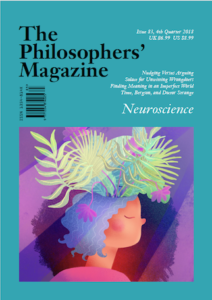 The Philosopher’s Magazine1
 “Learn what is true in order to do what is ‘right’ is the summing up of the whole duty of man.”– T.H. Huxley
 “Truth does not change because it is, or is not believed by a majority of the people.” – Guido Bruno (burned at the stake for heretical philosophical beliefs in 1600).


