
MEDITATION
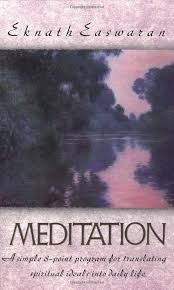 Having reviewed Easwaran’s interpretation of Hindu metaphysics, theology, cosmology, and the key principle of the unitive state, we turn at last to meditation – the first part of the eight-part program presented in his remarkable book, Meditation.60 (I will discuss the other seven parts in the next blog).
Meditation, for Easwaran, appears to rest on a foundation of five principles:
- Dharma, “the central law of our being, which is to extinguish our separateness and attain Self-realization to lose ourselves and be united with the Lord.”61
- Yoga, the discipline one deploys to achieve the unitive state and samsara ending with Self-realization whereby one is resorbed in the Lord and achieves ‘immortality.’
- The Guru or spiritual teacher, who can guide aspirants on their journey.63
- Faith or Shraddha– “that which is placed in the heart,”64 not mere blind faith, but “trust in spiritual values…that comes as our experience deepens”65 and that shapes and governs one’s life, thoughts, and actions.66
- Grace, the will of God to raise one to the highest level of consciousness.67
Meditation is no less than the method by which one can achieve the highest goal of human life, often called illumination, enlightenment, nirvana, self-Realization, or entering heaven.68 It is the path to a transcendental way of knowing (prajna) above reason wherein life is seen as a whole.69 One ascends through seven centers of consciousness terminating in the highest which Easwaran tells us is nothing but light – a light never seen by physical eyes – the complete unitive state (nirvikalpa).70 However while meditation promotes the ascent, one can only rise so high by one’s own efforts at which point God must pull one to the final summit.71
 Meditation is the practice of one pointed attention which Easwaran believes can be brief perhaps one-half hour per day.72 By quieting the mind, one progresses to a complete fullness (purnata), complete stillness and finally shanti, the “peace that passesth all understanding.”73 It is at this point that one can control prana for selfless purposes. Fail or succeed, we learn there is no wasted effort.74 The fruit of meditation is knowledge of the art of living.75 And, Easwaran tells us: “As meditation deepens, we shall find we are delivered from time into the Eternal Now.”76
Easwaran’s recommended form of meditation is to sit quietly in a designated space and focus the mind on a scriptural or enlightened phrase or quote77 – repeating it very slowly over and over, concentrating on every word. He offers many choices of phrase from Biblical psalms to Hindu or Buddhist quotations, but he suggests one start with St. Francis’ prayer: “Lord make me an instrument of thy peace…” Should this or any choice feel stale over time, he suggests using a new one.78 I will not try to explain his approach in more detail, but I urge any interested reader to acquire a copy of his book, Meditation.
(final continuation next post)
—————————————————-
60Easwaran also reviews his program in the preface of several of his other books.
61Easwaran, Eknath, The End of Sorrow. Nilgiri Press, Petaluma,California, 1985 . ISBN 0-915132-03-6, page 197.
62Easwaran, Eknath (translator) The Bhagavad Gita. Nilgiri Press, Petaluma,California, 2007. ISBN 978-1-58638-019-9, page 36.
63Easwaran, Eknath, The End of Sorrow. Nilgiri Press, Petaluma,California, 1985 . ISBN 0-915132-03-6, page 54.
64Easwaran, Eknath (translator) The Bhagavad Gita. Nilgiri Press, Petaluma,California, 2007. ISBN 978-1-58638-019-9, page 63.
65Easwaran, Eknath, Like a Thousand Suns. Nilgiri Press, Petaluma,California, 1979 . ISBN 0-915132-04-4, pages 73-74.
66Ibid., page 70.
67Easwaran, Eknath, The End of Sorrow. Nilgiri Press, Petaluma,California, 1985 . ISBN(A 0-915132-03-6, page 132.
68Easwaran, Eknath, Meditation. Nilgiri Press, Tomales, California, 1991. ISBN 0-915132-67-2, page 28.
69Easwaran, Eknath, Like a Thousand Suns. Nilgiri Press, Petaluma,California, 1979 . ISBN 0-915132-04-4, page 223. Also The End of Sorrow, page 148.
70Ibid., pages 129-130.
71Ibid., page 214.
72Easwaran, Eknath, The End of Sorrow. Nilgiri Press, Petaluma,California, 1985 . ISBN(A 0-915132-03-6, pages 89 and 364.
73Ibid., pages 138-140.
74Ibid., page 384.
75Easwaran, Eknath, Like a Thousand Suns. Nilgiri Press, Petaluma,California, 1979 . ISBN 0-915132-04-4, page 136.
76Easwaran, Eknath, The End of Sorrow. Nilgiri Press, Petaluma,California, 1985 . ISBN(A 0-915132-03-6, page 59.
77Easwaran does not think meditation means making one’s mind blank nor is it self-hypnosis.
78Easwaran, Eknath, Meditation. Nilgiri Press, Tomales, California, 1991. ISBN 0-915132-67-2, pages 7-56.


