
THE UNITIVE STATE
Easwaran calls the endpoint of human evolution – individually and collectively – the unitive state. He regularly brings up this summum bonum throughout his writing in the form of two nuances he calls unity of life and unity of consciousness. Of course they are really one and the same.
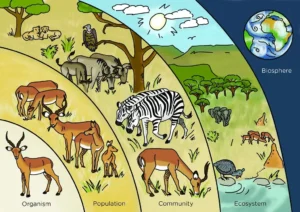 Unity of life refers to the common indwelling reality inside all material forms within the phenomenal world and their interconnectedness. For Earth-bound phenomena, this unity is instantiated in a whole, the environment, where the science of ecology confirms the interpenetrating relationship among all things living and non-living.47 In fact, Easwaran believes science confirms the spiritual truth that all life is one.
Easwaran emphasizes that the unity of life is an unalterable law, in fact, the central law of existence. Suffering occurs due to our violations of this law.48 He also points out that unlike the laws of science this law never changes.49 He thinks science is fundamentally the knowledge of the parts whereas spiritual knowledge encompasses the whole 50 As such, the recognition of the unity of life is not mainly an intellectual process, but a spiritual one. Easwaran goes still further: “Religion is the realization of the unity of life”51
Unity of consciousness refers to a deep internal experience. “It is the essence of the mystical experience to enter into the depths of consciousness and discover that none of us is separate from the rest of life. All creation is part of is part of one infinite reality – or in a more personal language, all of us are one.”52 Meditation takes us down the path to unity of consciousness and our true identity: “With all our consciousness gathered to an intense focus within, the boundaries which separate us from the rest of the world disappear. The duality of subject and object, knower and known, falls away; we are opened to transcendental mode of knowing.”53
We have come to Hinduism’s ultimate truth: “Tat tvam asi” (“Thou art that”) or advaita (‘not two”) – the supreme reward of inner contemplation of the self. However, at first, the experience of the unitive state is brief so it must constantly be rehearsed.54 How do we know when it is achieved more fully? The signs of attainment, Easwaran tells us, are “self-knowledge, the banishing all selfish desires, selfless action, and the expression of ‘original goodness.’55 He repetitively uses the example of Gandhi.
“Unification of consciousness can turn the most ordinary of us into a spiritual force; this is the power of the unitive state that we enter in the climax of meditation, called samādhi in Sanskrit, when our heart, mind, and spirit come to rest in the Lord.”56 In other words, God, our consciousness, and the phenomenological world intersect at the unitive state.
 This is ‘heaven’ for Hinduism, not a separate place, but brahmanirvana – “the kingdom of heaven within.”57 This “spiritual Mt. Everest” is also called shama (perfect peace)58 and is a state of abiding joy in this life.59
(sixth continuation next post)
—————————————————-
47Easwaran, Eknath, The End of Sorrow. Nilgiri Press, Petaluma,California, 1985 . ISBN 0-915132-03-6, page 12.
48Easwaran, Eknath, Like a Thousand Suns. Nilgiri Press, Petaluma,California, 1979 . ISBN 0-915132-04-4, page 12.
49Consider how Newtonian physics was revised by Einsteinian relativity, or how the universe ‘enlarged’ once telescopes revealed other galaxies.
50Ibid.
51Easwaran, Eknath, The End of Sorrow. Nilgiri Press, Petaluma,California, 1985 . ISBN 0-915132-03-6, page 26.
52Easwaran, Eknath, Like a Thousand Suns. Nilgiri Press, Petaluma,California, 1979 . ISBN 0-915132-04-4, page 9.
53Easwaran, Eknath, Meditation. Nilgiri Press, Tomales, California, 1991. ISBN 0-915132-67-2, page 25.
54Easwaran, Eknath (translator) The Bhagavad Gita. Nilgiri Press, Petaluma,California, 2007. ISBN 978-1-58638-019-9, page 27.
55Ibid., page 61.
50Ibid.
56Easwaran, Eknath, The End of Sorrow. Nilgiri Press, Petaluma,California, 1985 . ISBN 0-915132-03-6, page 41.
57Ibid., page 330.
58Ibid., page 339.
59Ibid., page 357.
—————————————–
Having trouble leaving a question or comment? E-mail me at gregoryciliberti@gmail.com


