
EVOLUTION
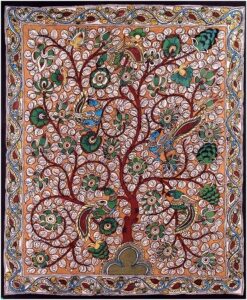 Easwaran claims the cosmos can be seen as a growing ‘Tree of Life’ which began in a cosmic soup.30 Its leaves are the universe and its root the eternal changeless Lord.31 The ‘Tree’ undergoes a continual process of evolution powered by prana, the primordial energy, which informs all the kinds of energy and matter with which we are familiar.32
According to the theory called sankhya, some 24 cosmic principles, akin to categories such as materiality, acted as ingredients which evolved into a field of forces that blended into the phenomena of the world including individual persons.33 Among the earliest phenomena to appear were ahamkara or separateness, and buddhi – the faculty that differentiates among various entities.34 Over time life forms appeared and developed mind and senses, which then evolved different levels of consciousness. Easwaran tells us consciousness is made up of a kind of umolded clay called chitta.35 Life struggled up the scale of consciousness via evolution (‘the divine game’) arriving at Homo sapiens.36 Nonetheless while what began as unitary consciousness evolved into the countless forms of sensory experience that followed, the unitary consciousness remains forever the most basic and deepest type. 37
For Easwaran, the evolution of life occurs through reincarnation of the individual jiva (the individual, separate soul) as it ascends the ladder of biological species to the human being and a return to the divine source.38 After millions of years, the gunas in each person exist in different proportions thus explaining the variety of human personalities and attributes.39 However, human nature and society must evolve across the gunas.  The most primitive humans were dominated by tamas – limited knowledge and thought – where prana powered survival. We are in the stage of civilization which is dominated by rajas– manipulation and mastery of nature – where prana powers progress. The next level in human development is sattva – transcendence, meaning, and value – where prana powers samadhi (union with God).40 For this to happen we must, as individuals, abandon our antiquated ideas, self-interest, institutions, and nationalism in order for us and for society as a whole to arrive at the highest evolutionary state.41
Thus cosmic evolution is mirrored in our individual existence. The divine fragment travels through time from one stage to the next in our evolution. But there are two forces of evolution that pervade current human life; the upward surge of evolution and the downward pull of our evolutionary past.42 Individual transformation begins at tamas (inertia and unconsciousness), and through activity and the choice to delay nothing brings one to rajas (ordinary mind, materialism). The final steps of meditation, forgiveness, and selfless activity, bring about sattva (the higher mind beyond time, space, and causality to immortality).43 In other words, we play a key part in our own spiritual evolution. “Sadhana [the discipline of yoga leading to Self-realization] is really the culmination of evolution.”44
The fully evolved human is unmoved by the gunas, detached, undisturbed, beyond likes and dislikes and thus is unlimited in time, place, circumstance, and obtains a lasting beneficial force called kundalini. At that point the human being exists in service to God with steadfast love. Thus the endpoint of evolution is merged consciousness with the divine and the unitive state.45 Krishna (and presumably those who achieve samadhi) alone will survive the end of the cosmos.46
(fifth continuation next post)
—————————————————-
30Easwaran, Eknath, To Love Is to Know Me. Nilgiri Press, Petaluma,California, 1985 . ISBN 0-915132-05-2, page 55
31Ibid., page 174.
32Ibid., page 203.
33Ibid., pages 52-57.
34Ibid., pages 56.
35Ibid., pages 78.
36Ibid., pages 90.
37Ibid., pages 54.
38Ibid., pages 112.
39Ibid., pages 113.
40Ibid., pages 311.
41Ibid., pages 370.
42Ibid., pages 456.
43Easwaran, Eknath, The End of Sorrow. Nilgiri Press, Petaluma,California, 1985 . ISBN 0-915132-03-6, page 95.
44Easwaran, Eknath, To Love Is to Know Me. Nilgiri Press, Petaluma,California, 1985 . ISBN 0-915132-05-2, page 57.
45Easwaran, Eknath, The End of Sorrow. Nilgiri Press, Petaluma,California, 1985 . ISBN 0-915132-03-6, page 39.
46Easwaran, Eknath, Like a Thousand Suns. Nilgiri Press, Petaluma,California, 1979 . ISBN 0-915132-04-4, page 121.
—————————————–
Having trouble leaving a question or comment? E-mail me at gregoryciliberti@gmail.com


