
We continue now with Liezi’s portrait of ultimate reality and human participation therein.
 The sixth chapter, Endeavor and Destiny, contrasts the ways of humanity or ‘endeavor’ with the course of nature or ‘destiny’ (ming). Liezi tells us that while people think they accomplish things by their own efforts, in truth, they are destined to achieve wherever they succeed. However Liezi is not advocating strict fatalism regarding our actions, only reiterating the desirability of following the path of natural spontaneity rather than of premeditated action. He uses the analogy of the swimmer following the current rather than fighting against it.5
In the eighth chapter, Explaining Conjunctions, he solidifies this principle suggesting that the coincidence of seemingly chance events informs how one ought to act. Again we are encouraged to discard societal conventions and preconceived goals in order to align ourselves with nature’s procession Liezi uses the example of one’s shadow which mirrors the shape of the body and follows its actions. Similarly, we are urged to track the non-human world in which we find ourselves.6
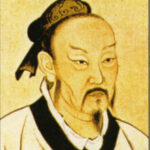 Finally we back up to the seventh chapter, Yang Zhu, which offers a different nuance of spontaneity. Yang Zhu was often attacked by the Confucians for his reported selfishness when he said he would not be willing to sacrifice one hair from his shin to save an empire. Liezi parlays this into the choice of a hedonistic self-indulgence and pursuit of pleasure as another spontaneous and natural choice for the Taoist. Like the Epicureans, however, he warns us of the ills of over-indulgence. In short, the life of disciplined pleasure and enjoyment free of conventional restraints can be seen as an alternative path of genuine spontaneity.7
We close now with the following quote from one of the apocrypha discourses inspired by the I Ching hexagram Ch’ien, the Creative. It attributes to Liezi the following mystical description of ultimate reality framed as a translation of the 14th chapter of the Daodejing:
“It is said (by Lieh-tsu): There is a primal change, a primal beginning, a primal origin, and a primal creation. The primal change is the state in which energy does not yet express itself. The primal beginning is the state in which energy originates; the primal origin is the state in which form originates; the primal creation is the state in which matter originates. When energy, form, and matter are present, but not yet separate, we call this chaos. Chaos means the state in which all things still exist mixed together and have not yet separated one from another. If one looks at it there is nothing to see; it if one listens to it there is nothing to hear; if one follows it one obtains nothing.”8
Once again I leave the reader to reflect on words that stop one’s thinking in its tracks.
—————————————–
5McGreal, Ian P. (editor) Great Thinkers of the Eastern World. HarperCollinsPublishers, New York, 1995. ISBN 06-270085-5, page 78.
6Ibid.
7Ibid., pages 78-79.
8Wilhelm, Hellmut, Change – Eight Lectures on the I Ching. Princeton University Press, Princeton New Jersey, 1973. ISBN 0-691-01787-5, page 82. The Westerner is reminded of the hierarchy of Platonic metaphysics.
—————————————–
Having trouble leaving a question or comment? E-mail me at gregoryciliberti@gmail.com


