
 “Whoever has God in mind, simply and solely God, in all things, such a man carries God with him into all his works and into all places, and God alone does all his works. He seeks nothing but God; nothing seems good to him but God. He becomes one with God in every thought. Just as no multiplicity can dissipate God, so nothing can dissipate this man and make him multiple.” – Meister Eckhart.1
In the last post we reviewed the five key metaphysical components of ultimate reality presented in the Gita – Brahman, atman, non-duality, the gunas – sattva, rajas, and tamas, and true freedom through moksha. We will now look deeper into the theology offered in this sacred text. Again we find five key concepts expressed.
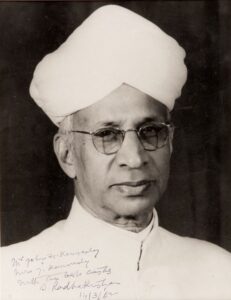
First unsurprisingly God is the active form of Brahman in the cosmos. Eknath Easwaran explains that the Upanishads report: “Below the flux of things with ‘name and form’ however they found something changeless: an infinite, indivisible, reality in which the transient data of the world cohere. They called this reality Brahman: the Godhead, the divine ground of existence.”2 Sarvepalli Radhakrishna (1888-1975), an Indian philosopher and former President of India, notes the Gita indicates Brahman manifests in physical reality as the ‘Supreme Person’ or Purusottamata, the Lord of the Universe and the abode of Brahman. God goes by many names, for example Isvara and Vishnu in the Vedas, but the multiple names ultimately refer to a single God.3
However, the Gita goes further than perhaps any other major religious text ever when Krishna suggests to Arjuna that all of the gods of the world’s religions are really the same, that is Krishna Himself. Consider:
“As they approach me, so I receive them. All paths, Arjuna, lead to me.”4
Or an alternate translation:
“Human beings follow my path universally, O Partha [Arjuna].”5
And elsewhere (Krishna speaking):
“When a person is devoted to something with complete faith, I unify his faith in that.”6
Or alternatively:
“I grant unwavering faith to any devoted man who wants to worship any form with faith.”7
Or one more translation:
“Whoever, with faith, has offered love to whatever from that person desires to worship – Upon every such person, I bestow this immovable faith.”8
For this reason Hinduism appears ultimately ecumenical. None of the other major religions seems to take quite this stance. Compare Krisna’s inclusiveness with Jehovah’s dictum: “Thou shalt have no other gods before me.” (Exodus 20:3). The Gita seems to imply that devotion to the reality of the divine is sufficient for spiritual connection, and that religious doctrine is relatively unimportant, even superfluous.
(continued next post)
—————————————————————
1Easwaran, Eknath (translator) The Bhagavad Gita. Nilgiri Press, California., 2007. ISBN 978-1-58638-019-9, page 56.
2Ibid., p. 24.
3Magill, Frank N. and McGreal, Ian P. (editors), Masterpieces of World Philosophy. HarperCollinsPublishers, 1990. ISBN 0-06-270051-0, page 15. (This from their summary of Radhakrishnan’s interpretation of the Gita).
4Easwaran, Eknath (translator) The Bhagavad Gita. Nilgiri Press, California., 2007. ISBN 978-1-58638-019-9, page 117 (Bhagavad Gita 4:11).
5Schweig, Graham M. (translator), Bhagavad Gita. HarperOne, New York, 2007. ISBN 978-0-06-199730-3, page 72.
6Easwaran, Eknath (translator) The Bhagavad Gita. Nilgiri Press, California., 2007. ISBN 978-1-58638-019-9, page 154 (Bhagavad Gita 7:21).
7Miller, Barbara Stoler (translator), The Bhagavad Gita, Quality Paperback Book Club, New York, 1998. Page 73.
8Schweig, Graham M. (translator), Bhagavad Gita. HarperOne, New York, 2007. ISBN 978-0-06-199730-3, page 113.


