
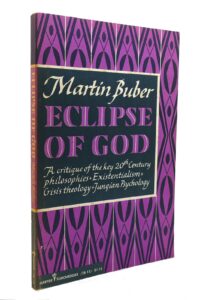
 Eclipse of God
Much less well known than I and Thou, and written some thirty years later, Eclipse of God carries an astonishing hypothesis. Buber theorizes that prehistoric and ancient people – including many early philosophers such as Heraclitus and Plato – recognized the divine through relation to the eternal Thou. Only later, after Spinoza, did philosophy begin in earnest to objectify God – particularly in the thoughts of Kant (“God is not an external substance, but only a moral condition within us.”13). Such objectification led to the loss of relation with the eternal Thou and finally Nietzsche’s assertion that “God is dead.” Buber claims this is a flawed construction; the objectification of the divine only eclipses Him, preventing some from recognizing He still exists (just as the Sun still exists when eclipsed by the moon even though it is not then visible from Earth).

Buber believes any conceptualizing of God must be balanced with a living relationship. In fact, images and abstract thought regarding God can only be translated into true knowledge of Him through a relation of love. Moreover faith is instantiated by living in relationship to the eternal Thou which produces indisputable confirmation of His existence. Those in this relation follow the ‘Way of God’ wherein there is a unity of salvation and essence, the true sphere of the knowledge of God being visible in His action.14 Buber tells us “The religious essence in every religion can be found in its highest certainty…that the meaning of existence is open and accessible in the actual lived concrete, not above the struggle with reality but in it.”15
Finally, as Pascal taught, in order for the philosopher to know God, he must “admit the fact that his idea of the Absolute [must dissolve] to the point where the Absolute lives; that it [is] dissolving at the point where the Absolute is loved; because at that point the Absolute is no longer the ‘Absolute’ about which one may philosophize, but God.”16
(third continuation next post)
——————————————————–
13Buber, Martin, Eclipse of God. Harper and Brothers Publishers, New York, 1952. Page 51.
14Ibid., page 33.
15Ibid., page 33.
16Ibid., page 50 (tense modified).


