
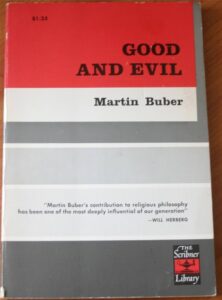
 Good and Evil
One year after the publication of Eclipse of God, Buber published this text in which, it seems to me, he suggests a path to relation with the eternal “Thou” for those of us still perplexed by the devastating truth of the earlier book that we cannot ascertain God’s existence objectively, but must instead pursue a subjective approach. In the section titled Right and Wrong, Buber outlines this pathway by resequencing five biblical psalms. For our purpose, let’s bracket the question of biblical authority and construe the message existentially, that is, as lived experience.17
Buber starts with Psalm 12 – consider verses 1-2: “Help, O Lord, for there is no longer anyone who is Godly; the faithful have disappeared from humankind. They utter lies to each other; with flattering lips and a double heart they speak.” Surely most of us experience at least a component of secular inauthenticity pervading modern civilization.
Next is Psalm 14 – consider verses 1 and 5 – “Fools say in their hearts, ‘There is no God.’ They are corrupt, they do abominable deeds; … they shall be in great terror, for God is with the company of the righteous.” I think Buber wants to demonstrate that the rejection of a genuine foundation for ethics fosters vice in the world. Those who resist evil and promote good embark on the path towards relation with God which is denied to the ethically sightless.
Third is Psalm 82 – note verses 4, and 6-7 – “Rescue the weak and the needy; deliver them from the hand of the wicked…I say ‘You are gods, children of the most High, all of you; nevertheless, you shall die like mortals’…” Buber infers a divine sanctuary for persons devoted to good while evil persons, though made in the image of God, cannot achieve relationship with Him and thus die within their blindness.
 Fourth is Psalm 73 – especially verses 26-28 – “My flesh and my heart may fail, but God is the strength of my heart and my portion forever. Indeed those who are far from You will perish…But for me it is good to be near God…”18 Buber is clear; evil persons may appear to flourish while moral persons suffer, but this is an illusion. The despair of our existential circumstances is vanquished by the illumination of divine presence, wherein meaning arises out of meaninglessness.
Finally, Psalm 1 – especially verses 1-2 – “Happy are those who do not follow the advice of the wicked, or take the path that sinners tread, or sit in the seat of scoffers; but their delight is in the law of the Lord, and on his law they meditate day and night.” Buber completes the pathway for us: rebuke evil tendencies, remain open to the divine constitution of reality, and contemplate the moral (divine) law, and relation to the eternal “Thou” ensues.
I am sure some readers will think this post is too religious for a philosophical blog, but the wisdom literature of the Bible (which includes Psalms) represents the highest philosophical reflections of the ancient Hebrews, and a thoughtful reinterpretation by the likes of Martin Buber justifies our consideration. In the end, we advance if we resist allowing our bias to block the opportunity for greater understanding.
(final continuation next post)
——————————————————-
17The reader must also excuse my lack of a theological background while reading my imperfect exposition.
18These seem to me to be among the most powerful words in the entire Bible. I hope the reader can bracket the source and recognize the sheer power of the thought expressed.


