
GOD
Easwaran is clear thoughout his writing, if ultimate reality can be encompassed in one term, that entity is the singular divine entity, which he most often refers to as Krishna, but frequently as God or Lord as well. The Sanskrit root of Krishna is krish meaning ‘to draw’ and so Krishna “is the one inside us who is drawing us to himself all the time.”7 In their search for the ultimate, the mystics of the Vedas and the Upanishads found below the “flux of things, with ‘name and form’ … something changeless: an infinite, indivisible reality in which the transient data of the world cohere. They called this reality Brahman: the Godhead, the divine ground of existence.”8
The Hindus ascribe five characteristics to this deity:9
- Aksharam –inexhaustible, imperishable, without beginning or end, unborn and undying.
- Anirdeshyam- cannot be pointed at, described, or defined (there is nothing else from which it can be distinguished), neither inside nor outside, hence subject and object are one.
- Avyaktam – unmanifest, formless, unable to be seen.
- Sarvatragam – everywhere, Existence itself.
- Acalam – unshakeable, beyond all change.
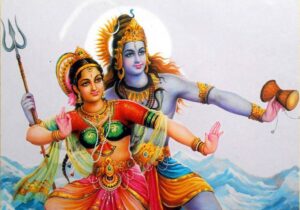 Krishna is also both Vistharah – “he who has expanded himself” and Sthāvarasthānuh – “he who is completely still”10 Krishna is all throughout the universe and Chitragupta, the ‘cosmic accountant,’ who creates balance in the universe.11 Alternatively, the Godhead is Shiva (male- changeless) and Shakti (female – power, strength, dynamic). The two are always united.12
Metaphysically, God is time, reason, science,, wisdom, the seed of creativity in every being, but also death and the destroyer. The Lord is both the Law and the lawgiver. He/she is the beginning, middle and end.13 But Krishna is also Pranada, the source of the most basic energy and power (prana) which flows into all phenomenal things and unites all,14 and Pavaka, the fire that purifies.15 God is also the Supreme Poet – creator of beauty.16
 There’s more – God is both personal and impersonal and neither.17 As personal, Krishna is the Lord of Love, but this ‘love’ is not only a reciprocal love between God and us, but also of us for each other. God is also the Forgiver. The infinite love of God is the unifying force of the universe and thus is inbedded in prana and Pavaka. But the Lord has two ‘faces’ one is love and the other is karma.18 Last, Krishna or Brahman is the ‘God’ of all religions19 and assumes avatars or divine incarnations in human form for teaching his eternal Truths.20
(third continuation next post)
—————————————————-
7Easwaran, Eknath, The End of Sorrow. Nilgiri Press, Petaluma,California, 1985 . ISBN 0-915132-03-6, page 28.
8Easwaran, Eknath (translator) The Bhagavad Gita. Nilgiri Press, Petaluma,California, 2007. ISBN 978-1-58638-019-9, page 24.
9Easwaran, Eknath, Like a Thousand Suns. Nilgiri Press, Petaluma,California, 1979 . ISBN 0-915132-04-4, page 339.
10Ibid., page 11.
11Ibid., page 282.
12Easwaran, Eknath, To Love Is to Know Me. Nilgiri Press, Petaluma,California, 1985 . ISBN 0-915132-05-2, page 99.
13Easwaran, Eknath, Like a Thousand Suns. Nilgiri Press, Petaluma,California, 1979 . ISBN 0-915132-04-4, page 244-249.
14Ibid., page 209.
15Ibid., page 228.
16Ibid., page 102.
17Easwaran, Eknath, The End of Sorrow. Nilgiri Press, Petaluma,California, 1985 . ISBN 0-915132-03-6, page 148.
18Easwaran, Eknath, Like a Thousand Suns. Nilgiri Press, Petaluma,California, 1979 . ISBN 0-915132-04-4, page 316.
19Ibid., page 179.
20Ibid., page 76. Especially Krishna, Buddha, and Christ.


