
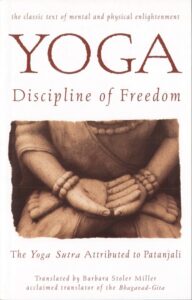
Last time we examined very briefly the metaphysics of Patanjali. However, what makes his text, the Yoga Sutra, unique is not his philosophy as much as the discipline he describes. Unlike the Upanishads in which moksha depends on the hope of uncertain mystical union, or the Bhagavad Gita where it is achieved by three ill-defined paths (devotion, action, and knowledge),  Patanjali offers a virtual step-by-step manual of a fifth path to enlightenment. In Barbara Stoler Miller’s words, spiritual liberation “is not realized through mystical experience but through a logical series of meditative practices and hyperconscious thought experiments.”6 Who can fail to be intrigued?
We begin with Patanjali’s assessment of human psychology. The human mind suffers from mental fluctuations (citta vrtti or mental chatter) – a de facto “tyranny of private mental chaos and moral confusion.”7 Thought in turn binds the spirit to the physical thereby enslaving it to the world of pain. Cessation of the turning of thought decouples the spirit from prakriti. But the problem runs deep – memories of past experiences, patterns of thought, and false identities leave ‘seeds’ (bija) that must be voided. The discipline described in the Yoga Sutra offers a painstaking means to escape. In Patanjali’s own words: “Yoga is the cessation of the turnings of thought.”8 (page 29; 1: 2)
When one proceeds without these ‘seeds’ (mirbijasamadhi) one achieves a hyperconscious condition, direct knowledge without intellectual activity, and the experience of spiritual freedom. This is the paradox Patanjali uncovers: freedom comes from discipline.
It is not the mission of this site to restate his method in detail (in fact the manuscript itself is quite short and can be read in an afternoon), but a summary seems reasonable. The text is divided into four parts: (1) concentration (samadhi), (2) practice (sadhana), (3) empowerment (vibhuti), and (4) isolation (kaivalyam). The first two steps cultivate the ability to discern the difference of the “seer’ from the ‘seen.’ This comes from the application of dispassion and the restraining of thought. Once one masters the mind and dwells in the state of ‘pure seeing,’ one arrives at isolation – including freedom from negative influences and absorption in a ‘cloud of virtue.’ The practices prescribed include meditation (for example chanting, controlled breathing, one-pointedness, detachment, postures, and withdrawal and control of the senses) and lifestyle (austerity, study, non-violence, truthfulness,and sexual restraint among others).9
 Patanjali’s endpoint is union with the deity, avoidance of future karmic adversity, and higher levels of personal empowerment. In short, he offers a road map for a fifth means to achieve moksha – meditation (rajas yoga). We now have the complete set of Hindu models of human connection to ultimate reality. From here we round out the picture we have sketched by looking at three remaining key thinkers in this tradition and one recent thinker who reworks the metaphysics and spiritual connectivity to fit modernity.
——————————————————-
6Miller, Barbara Stoler (translator), Yoga: Discipline of Freedom. Bantam Books, New York, 1998. ISBN 978-0-553-37428-5, page x.
7Ibid., page 2.
8McGreal, Ian P. (editor) Great Thinkers of the Eastern World. HarperCollinsPublishers, New York, 1995. ISBN 0-06-270085-5, page 180-181.
9Ibid.


