
 “What exists in truth is the Self alone.” – Bhagavan Sri Ramana Maharshi
This month an Indian friend, learning that I plan to examine ultimate reality as presented in the Hindu tradition next, provided me a link to this roughly 4,000 word text1 which I would like to explore as a preface to that investigation. The text begins with a very informative and concise introduction where we learn that in 1902 a philosophy graduate named Sri M. Sivaprakasam Pillai visited the guru, Bhagavan Sri Ramana Maharshi, in Virupaksha Cave on Arunachala Hill and posed 28 questions2 related to ‘Self-enquiry.’ This current reading then is a transcript of the dialectic that took place. It was first released in 1923 although the current English text has a publication date of 2010.
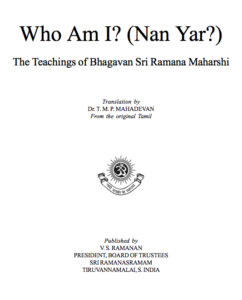 The basic proposition of Who am I? (Nan Yar) is straightforward enough: the direct path to liberation (enlightenment?) is by a process called ‘Self-inquiry.’ That is to say one can achieve mind control and eliminate interfering thoughts by a disciplined focusing of the mind on the fundamental question of one’s own identity – literally asking oneself, “Who am I?” And if the mind wanders to other thoughts, redirection is achieved by asking oneself “To whom do they arise?” This astonishingly simple, yet challenging, approach permits access to the single-pointedness that launches one on the path to freedom from perplexity and suffering.
The Maharshi explains: the mind consists of thoughts of which the first and most rudimentary is the “I”-thought. The process of ‘Self-inquiry’ terminates in the “I”-thought which itself finally vanishes leaving only the supreme non-dual Self. At that stage the non-self, including the body and the mind, dissipates resulting in illumination or sakshatkara. Vigilance against other thoughts, possibly aided by breath control and meditation, is essential to bring about the quiescent mind and one-pointedness wherein the “plenary Reality” of Self is realized in a state referred to as “Silence.”3
Other key principles expressed by the Maharshi in this text include (in order of appearance):
- “All living things desire to be happy always.”4
- After abandoning body, senses, and mind as one’s true self, “that Awareness which alone remains – that I am.”5
- “Thought is the nature of the mind.”6
- The world is not real.7 “The mind projects the world out of itself and again resolves it into itself.”8
- “What is referred to as the Self is the Atman.”9
- When all thoughts are eliminated including the I-thought, “there will arise Self-realization.”10
- “Whatever one does, one should do without the egoity ‘I’. If one acts in that way, all will appear as of the nature of Siva (God).”11
- “Both desire and hatred should be eschewed…behave with humility.”12
- “It is by virtue of the mere presence of God that the souls governed by the three (cosmic) functions or the fivefold divine activity perform their actions and then rest, in accordance with their respective karma. God has no resolve; no karma attaches itself to Him.”13
- “Giving oneself up to God means remaining constantly in the Self without giving room for the rise of any thoughts other than that of the Self.”14
- “There is no need for endless reading…There will come a time when one will have to forget all that one has learned.”15
- “Happiness is the very nature of the Self; happiness and the Self are not different.”16
- “The mind of the one who knows the truth does not leave Brahman.”17
- “Desirelessness is wisdom.”18
- “Meditation consists in thinking that one’s self is Brahman, Existence-Consciousness-Bliss.”19
Next time I will offer my thoughts on the Maharshi’s philosophy.
(continued next post)
—————————————————
1The text is available at gururamana.org. Once there, go to the Resources tab and click on Publications where you will find : Who Am I? in PDF form for most major languages including of course English.
2Some earlier editions condensed the manuscript into just 13 questions, but the current version has 28.
3Ibid., page 7.
4Ibid., page 11.
5Ibid., page 13.
6Ibid., page 16.
7Ibid., page 15.
8Ibid., page 16.
9Ibid., page 17.
10Ibid., page 19.
11Ibid., page 20.
12Ibid., page 26.
13Ibid., page 29.
14Ibid., page 30.
15Ibid., pages 34-35.
16Ibid., page 35.
17Ibid., pages 36-37.
18Ibid., page 38.
19Ibid., page 39.


