
THE DIVINE BEING
The second element of ultimate reality identified by our five sources is the divine being or God.1 Consensus ‘characteristics’ of God include: eternal, necessarily existent, singular, simple (indivisible), unchangeable, original, supreme, perfect (beneficent), incomprehensible, unimaginably powerful, and visually inconceivable.2 Maimonides wavers regarding such linguistic absolutes, believing that we cannot understand the actual deity through comparisons to our experiences of the world or by the workings of our limited intellectual faculties. Thus while this list of characteristics may be the best possible, it is still flawed; God is beyond all characterization. Meanwhile the Kabbalists seem to superadd even the abstract elements of reality described last time as emanations of the highest level of the divine being.
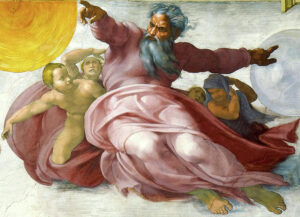
Nonetheless, God has agency as evidenced three ways. First God is seen as creator of the universe and its governing laws. We saw that Maimonides argues our best understanding of the deity derives from examination of his works (the universe). Second God is the source of the divine (moral) law. All of our featured texts urge compliance with this law as a critical step on the pathway to knowledge of God and fulfillment of humanity’s role within the cosmos. The third demonstration of divine agency is the Old Testament – God’s revelation of Himself – which the Kabbalists tell us is the optimal format by which we can understand God given our creaturely limitations.

Finally God is a subject, perhaps reasonably considered ‘personal.’ Interface with God may develop by means of biblical teachings such as meditation on Psalms (prayer), through mystical experience as suggested by Philo and the Zohar, via love and imitation of the divine as advanced by Maimonides, and existentially by means of a relation with the “eternal Thou” according to Buber. In a sense these are all the same, though they are nuanced a bit differently.
(further continued next post)
——————————————
1While the reader might expect belief in God to be universal among followers of Judaism, in fact, I have on several occasions and by different followers been informed that Judaism can be practiced regardless of one’s belief in God. This however is a discussion more appropriate to theologians defining the word ‘religion’ than philosophers.
2I do not think these characteristics equate to such philosophical terms as omniscient, omnipotent, and omnibenevolent. For instance the issue of God’s ability to predict free will or know the future of human actions is unaddressed as best I can tell. Alternatibely while God is immensely powerful, there is no indication that God is capable of logically impossible actions such as making 2 + 2 = 5. Moreover both the Bible and most of these thinkers see Evil as instantiated in God’s creation suggesting limits to God’s benevolence.
—————————————–
Having trouble leaving a question or comment? E-mail me at gregoryciliberti@gmail.com


