
After we learn that ultimate reality for Maimonides is simply God and his works, we are not surprised to find that knowledge of God is the summum bonum leading us to an authentic connection with Him and to immortality, bliss, supreme beatitude, and true love of God.3 Recognition that God is constantly observing us awes and humbles us while the most complete knowledge of God possible to us entails knowing that we are unable to truly comprehend him.4
We can extract from Maimonides’ texts the three necessary steps that lead to the knowledge of God. It begins with faith and a concommittant intuitive perception expressible only in symbols and similes. This approach offers greater access than an intuitive conception which in turn exceeds that which philosophy alone can offer. In any case, “only by way of conceptual comprehension is it possible to attain true knowledge of God, and thereby true communion with God.”5
 The second prerequisite is the ethics communicated in the divine law (the Law), which, Maimonides asserts, is not mere political law (relations or persons to one another), but much more, nothing less than the means to perfect one’s soul by communicating the supreme truth in a form understandable to oneself. Objectives of divine law include the social well-being and individual freedom which permit one to seek God and an ethical discipline that liberates the spirit. In short the divine law is the path to God.
Maimonides adds another reason ethics are essential. “It is clear, and proved by evidence that moral virtues are a prerequisite for intellectual virtues.”6 especially the serenity and equanimity essential to the contemplative life. Borrowing from Aristotle and supplemented by his biblical exegesis, Maimonides believes we must pursue the middle way, that is, the “way of the wise man.”7 The first commandment of his Laws Concerning Character Traits (Hilkhot. De’ot) is to imitate God’s ways including strict control of bodily desire8 and piety beyond requirements of the law.9 Piety includes a regimen of curing the disease of the soul (vice or sin) done by repeated performance of actions opposed to one’s vice.10 However Maimonides rejects asceticism – in fact, he encourages the embrace of beauty and joy of the mind.11 as essential to human efforts at apotheosis.
( further continued next post)
———————————————————-
3 Chaim, Rabin (translator), Maimonides: The Guide of the Perplexed. Hackett Publishing Company, Inc., Indianapolis/Cambridge, 1995. ISBN 0-87220-324-7, page ix. The knowledge of God is, in fact, the only true good.
4Magill, Frank N. and McGreal, Ian P. (editors), Masterpieces of World Philosophy in Summary Form. Harper & Row, Publishers, New York, 1961. Page 303.
5Chaim, Rabin (translator), Maimonides: The Guide of the Perplexed. Hackett Publishing Company, Inc., Indianapolis/Cambridge, 1995. ISBN 0-87220-324-7, page 9
6Ibid., page 61.
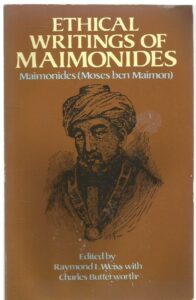
7Weiss, Raymond L. and Butterworth, Charles (editors), Ethical Writings of Maimonides. Dover Publications , Inc., New York, 1975. ISBN 0-486-245222-5, page.6.
8Ibid., page 5
9Ibid., page 7.
10Ibid., page 11.
11Ibid., page 13.


