
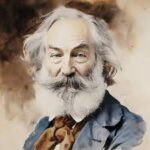
 “Within the purposes of the Cosmos, and vivifying all meteorology, and all the congeries of the mineral, the vegetable, and animal worlds – all the physical growth and development of man, and all the history of the race of politics, religions, wars, etc., there is a moral purpose, a visible or invisible intention, certainly underlying all … That something is the All, and the idea of All, with the accompanying idea of eternity, and of itself, the soul, buoyant, indestructible, sailing space forever.” – Walt Whitman1
In the last several posts we saw that for Kant, ultimate reality is the transcendental or noumenal realm revealed as reason, the thing-in-itself, God as implicit in reason and the moral law, and absolute good will. All are at least partly accessible to humans although to different degrees. Unquestionably one of the greatest followers on Kantian philosophy was Georg Wilhelm Friedrich Hegel (1770-1831) who was influenced by Kant, but rejected much of his thought. Hegel rejects the idea of a noumenal reality, and replaces Kant’s facets of the transcendental with four interlocking principles of his own: (1) Geist, or Mind (sometimes translated consciousness or Spirit), (2) Idea (perhaps also Logic), (3) Nature, i.e. the universe, and (4) History – specifically human history. Perhaps the most instrumental component of his system is his formulation of a final dialectic: thesis –> antithesis –> synthesis. But most compelling for us is the pivotal place of humanity in the self-revelation of the divine mind. Let’s examine his metaphysics in more detail.
GEIST
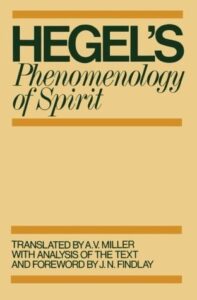 In Phenomenology of Mind, his first major work published in 1807, Hegel develops his central theory of Geist, sometimes translated as Spirit, but more often and presumably more accurately as Mind. Some authorities believe Hegel chose the word Geist specifically because of its ambiguous or dual meaning – connoting both a spiritual being and an absolute intelligence.
For Hegel, Geist is the intelligent and spiritual underpinning of the universe, a kind of divine entity that set in motion the universe following a preconceived but gradually developing plan. He seems to avoid the question of whether there is an ontological basis for Geist, but agues it can be deduced from its apparent penetration of all of reality. He characterizes Geist as the unity underlying the distinct sides of all facets of the world – that which integrates everything into a rational totality. Geist expresses three modalities; universality, specificity, and singularity. It is a consciousness, a subjectivity, a self-active universal in specific form confronting its subjectivity and thereby achieving self.
Hegel also calls Geist the Thinking Ego connected with the categories used in the synthetic constitution of objects by the understanding. It is the equivalent of the form of self. But it is not a personal thinker rather the “logical function of universality” and the place of forms. It has an implicit existence in natural objects as a sort of being beneath the surface of natural objects as the essences or forces which explain them.2
(continued next post)
————————————————————
1From Democratic Vistas. Quoted by Hartman, Robert S. in his introduction to The Library of Liberal Arts edition of Hegel, G.W.F., Reason in History. The Bobbs-Merrill Company, Inc., Indianapolis, IN, 1953. Page xv.
2Miller, A.V. (translator), Hegel’s Phenomenology of Spirit. Oxford University Press, Oxford, England, 1977. ISBN 978-0-19-824697-1, pages x-xi. Also see Phenomenology Sections 18, 152, 235, and 803 for particular descriptions. (Hegel’s systematic approach is very evident in his use of numbered passages to compartmentalize his thinking.)


