
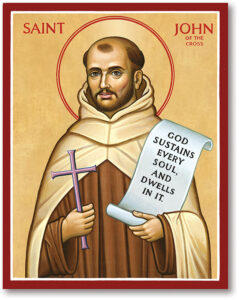
 “The fitting disposition for union with God is not that the soul should understand, feel, taste, or imagine anything on the subject of the nature of God, or any other thing whatever, but should remain in that pureness and love which is perfect resignation and complete detachment from all things for God alone.” – St. John of the Cross
In the last three parts of this segment on the Bhagavad Gita, we identified three perspectives from which ultimate reality can be viewed:
1. Metaphysically as the principles of Brahman, atman, monism, the gunas, and freedom (moksha),
2. Theologically as the unitary, supreme, infinite deity, common to all religions, who takes on historical incarnations and is personally interested in humanity.
3. Psychologically as the innermost depth of one’s consciousness where the atman and divinity are directly experienced.
We arrive now at the fourth perspective – ethically, that is, three concrete pathways of conduct or ‘yogas’ which actuate connection with the deific ultimate reality. Let’s begin with clarification of the term, yoga. It is derived from the Sanskrit root, yuj, meaning “to yoke,” but in the Gita, the reference is more specific, the yoking of oneself to Krishna (God) and divine purpose through spiritual and physical discipline.1  The yogas described in the Gita are three distinct approaches by which the unity of life is directly apprehended or experienced (samadhi).2 They are called bhakti yoga (the path of devotion), karma yoga (the path of action), and jnana yoga (the path of knowledge). Each can lead to the sacred connection of humanity and divinity sometimes called the “supreme secret of yoga.”3
The decision of which path to take is facilitated by considering first, which of the three personal attributes (gunas) dominates in oneself – inertia/innocence (tamas), energy/engagement (rajas), or mental clarity/rationality (sattva) – and second, which spiritual aptitude is one’s strength – knowledge, faith/love, activity, or meditation.4 One’s guna mix tends to reveal one’s temperament and character and determine one’s dharma or sacred duty and the ideal pathway.5 In turn dharma helps to sustain the moral order of the cosmos and serves as the ground for reciprocal relationship between cosmic and human action. In other words, the three yoga disciplines complete the circle of human conduct and ultimate reality. It is up to each of us to correctly identify our particular path that closes the circuit.
(continued next post)
——————————————————-
1Miller, Barbara Stoler (translator), The Bhagavad Gita, Quality Paperback Book Club, New York, 1998. Page 157. The reader should not confuse this use of the word yoga with that referring to the physical exercises practiced in a typical yoga class (more on this in the next segment on Patanjali’s Yoga Sutra).
2Easwaran, Eknath (translator) The Bhagavad Gita. Nilgiri Press, California., 2007. ISBN 978-1-58638-019-9, page 30.
3Schweig, Graham M. (translator), Bhagavad Gita. HarperOne, New York, 2007. ISBN 978-0-06-199730-3, page 3.
4Miller, Barbara Stoler (translator), The Bhagavad Gita, Quality Paperback Book Club, New York, 1998. Page xi. This is the subject of chapter 14 of the Gita.
5 McGreal, Ian P. (editor) Great Thinkers of the Eastern World. HarperCollinsPublishers, New York, 1995. ISBN 0-06-270085-5, page 177.


